ISO progressing development of international copper traceability standard

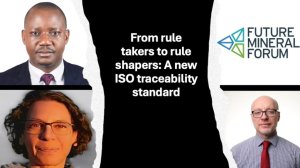
FMF strategy, programme and content director Aldo Pennini, ISO technical programme manager Mercè Ferrés Hernández and Africa Minerals Strategy Group chief of staff Patrick Mulindwa discuss the development of a new international copper traceability standard.


Nongovernmental organisation the International Organisation for Standardisation (ISO) is moving swiftly forward with development of an international copper traceability standard, which is expected to harmonise policies in this regard, as well as provide benefits for supplier-countries and artisanal miners.
The Future Minerals Forum (FMF), in partnership with Creamer Media, on December 10 hosted a webinar, 'From rule takers to rule shapers: Africa leads a new global minerals standard', which explored the development of this standard, as well as its relevance.
Moderated by FMF strategy, programme and content director Aldo Pennini, the panel of speakers included ISO technical programme manager Mercè Ferrés Hernández and Africa Minerals Strategy Group (AMSG) chief of staff Patrick Mulindwa.
Pennini explained that the FMF’s Ministerial Roundtable catalysed this pioneer initiative, having submitted a project to the ISO to develop an international traceability standard for copper. The standard would cover traceability from the mined ore to the purified metal, excluding the downstream segment of the supply chain.
The Ministerial Roundtable, posited to be the largest global gathering of Ministers responsible for minerals, kicks off the three-day 2026 FMF – a yearly event held in Riyadh, in Saudi Arabia, under the auspices of that country’s Ministry of Industry and Mineral Resources.
The event brings together leaders from government, industry and other stakeholders to develop initiatives to increase the production of minerals needed for economic development and electrification of countries to meet carbon-reduction goals.
As the global energy transition, electrification and digitalisation continue to gain momentum, copper has emerged as a key commodity underpinning these.
This was evidenced by the growing demand for copper over the past few years, with this trend expected to continue in the years ahead. Projections estimated that global demand for copper would increase by about 40% by 2040, Hernández pointed out.
While there were already several established traceability frameworks that were being successfully used to track copper, the ambition of the proposed new standard was to provide a singular, harmonised global framework that was suitable for all copper-producing contexts, she explained.
Copper is mined in several countries – with the Democratic Republic of Congo and Zambia, in Africa, and Chile and Peru, in South America – hosting the largest reserves; and the diverse geological settings across these jurisdictions resulting in a myriad of mining methods.
Owing to these factors, and growing demand, there is a need to ensure copper is sourced responsibly, and the challenges around this are mitigated.
Hernández highlighted that one of the strengths of the standard was that it would consider “maturity levels”, which was expected to enable organisations to adopt a development pathway reflecting their reality and capabilities.
While industrial mining dominated global output, artisanal copper mining played a critical role in Africa, especially, and was also present in Latin America and Asia, she indicated, and the standard therefore aimed to account for this.
“The standard is meant to be a tool for progress towards the level that global market demands, rather than a barrier to entry,” Hernández emphasised.
She posited that a harmonised standard would engender a shared language of trust for stakeholders, with benefits expected to include reduced compliance costs, enhanced data consistency and comparability for industry; easier verification of copper inputs across multiple suppliers for downstream buyers; and a simplified oversight with one global standard rather than fragmented compliance checks for regulators.
Hernández explained that, while ISO standards were voluntary, the organisation’s 170 members could adopt these into their national standards, and refer to them in national regulations for mandatory compliance, which then resulted in them becoming legally enforceable.
This would facilitate harmonisation of the international regulatory framework, which is desirable for cross-border activities, she averred.
Hernández also mentioned that the ISO would only develop a standard if there was a demonstrable global market need for it.
As such, all projects were required to pass a “global relevance test”, where ISO members were given 12 weeks to reflect on the proposal, consult their national stakeholders and make an informed decision regarding whether they would support the project and contribute to its development, she explained.
Hernández informed that the project was currently undergoing this process in the ISO Technical Committee 308, Chain of Custody, which would be the committee developing the project if approved. The “global relevance test” would conclude on February 24, and she called on relevant stakeholders to participate, especially those in supplier countries.
Hernández underlined the importance of this supplier-country leadership within the ISO processes, noting that this aligned with the organisation’s strategic priority of “All voices heard”.
Developing countries represent 75% of ISO members, but they are often under-represented in the technical work.
This project was aimed at ensuring that copper-producer countries brought their knowledge and expertise to contribute to shaping the expected global framework, Hernández stressed.
In this vein, the FMF has zeroed in on the Copperbelt in Africa as the space for initial work for the standard.
The ambition was for this to be developed over time, and serve as a model for potential replication in other minerals globally, Pennini informed.
The importance of the standard to supplier countries was echoed by Mulindwa.
African Ministers of minerals and mining established the AMSG during the third FMF in Saudi Arabia in 2024.
AMSG is dedicated to advancing Africa’s strategic interests in the minerals sector, fostering collaboration among African nations to ensure the continent plays a central role in the global energy transition.
Mulindwa welcomed the effort to provide certification that included the formalisation of artisanal mining.
He posited that the standard would help promote beneficiation and local value addition.
Mulindwa pointed out that the AMSG’s work had indicated that countries in Africa were keen to beneficiate, however, investors were often wary to allocate capital to some jurisdictions owing to transparency issues.
By providing a mark of assurance, he highlighted that this standard should engender positive results for the continent, helping to streamline responsible investment.
Following the webinar, Mulindwa also expressed the entity’s support for the development of the new standard.
“AMSG, through the Africa Responsible Mineral Sourcing Initiative, remains fully committed to advancing the Copperbelt ISO Certification Standards project and supporting initiatives that ensure African producers are central to global mineral governance, while fostering sustainable, transparent, and value-adding supply chains,” he emphasised.
Mulindwa informed that work undertaken in developing the standard would be reported back to the Ministerial Roundtable at the next FMF, scheduled for January. This aimed to ensure that the project was on track and all stakeholders were involved.
Article Enquiry
Email Article
Save Article
Feedback
To advertise email advertising@creamermedia.co.za or click here
Research Reports

Projects

Latest Multimedia

Latest News
Showroom

For over 60 years, VEGA has provided industry-leading products for the measurement of level, density, weight and pressure. As the inventor of the...
VISIT SHOWROOM
Sika South Africa is a trusted partner for the nation’s infrastructure, commercial, residential, and industrial sectors.
VISIT SHOWROOM


Announcements
What's On
Subscribe to improve your user experience...
Option 1 (equivalent of R125 a month):
Receive a weekly copy of Creamer Media's Engineering News & Mining Weekly magazine
(print copy for those in South Africa and e-magazine for those outside of South Africa)
Receive daily email newsletters
Access to full search results
Access archive of magazine back copies
Access to Projects in Progress
Access to ONE Research Report of your choice in PDF format
Option 2 (equivalent of R375 a month):
All benefits from Option 1
PLUS
Access to Creamer Media's Research Channel Africa for ALL Research Reports, in PDF format, on various industrial and mining sectors
including Electricity; Water; Energy Transition; Hydrogen; Roads, Rail and Ports; Coal; Gold; Platinum; Battery Metals; etc.
Already a subscriber?
Forgotten your password?
Receive weekly copy of Creamer Media's Engineering News & Mining Weekly magazine (print copy for those in South Africa and e-magazine for those outside of South Africa)
➕
Recieve daily email newsletters
➕
Access to full search results
➕
Access archive of magazine back copies
➕
Access to Projects in Progress
➕
Access to ONE Research Report of your choice in PDF format
RESEARCH CHANNEL AFRICA
R4500 (equivalent of R375 a month)
SUBSCRIBEAll benefits from Option 1
➕
Access to Creamer Media's Research Channel Africa for ALL Research Reports on various industrial and mining sectors, in PDF format, including on:
Electricity
➕
Water
➕
Energy Transition
➕
Hydrogen
➕
Roads, Rail and Ports
➕
Coal
➕
Gold
➕
Platinum
➕
Battery Metals
➕
etc.
Receive all benefits from Option 1 or Option 2 delivered to numerous people at your company
➕
Multiple User names and Passwords for simultaneous log-ins
➕
Intranet integration access to all in your organisation