A Phoenix Rises: SALT Reveals Massive Star WOH G64 is Still a Red Supergiant


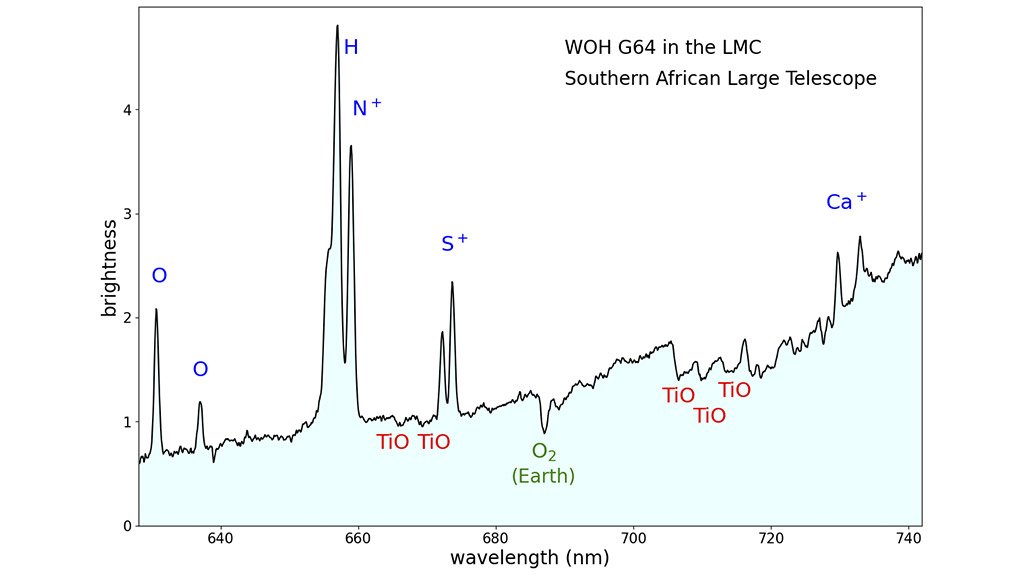



Astronomers using the Southern African Large Telescope (SALT) have solved a cosmic mystery surrounding one of the most extreme stars known, WOH G64. While recent dramatic fading led many to believe the star had evolved into a new phase or was nearing its end, new SALT observations confirm the "beast" of the Large Magellanic Cloud is still very much alive as a red supergiant.
WOH G64 has long been known as the most luminous, coolest, and one of the dustiest red supergiant stars in the Large Magellanic Cloud (LMC), a satellite galaxy of the Milky Way. Such massive stars are destined to end their lives in core-collapse supernova explosions. However, in the last decade, the star’s behaviour changed radically. It faded significantly, its pulsations suppressed, and its spectrum became dominated by emission lines from ionised gas rather than the cool absorption features typical of red supergiants.
This strange behaviour, coupled with the 2024 discovery of a fresh dust cloud veiling the star, led astronomers to speculate that the red supergiant phase had ended. Theories suggested it might have evolved into a yellow hypergiant—a brief, unstable phase preceding a supernova—revealing a hot companion star previously hidden by the supergiant's glare.
To determine the star's true fate, a team led by Dr Jacco van Loon (Keele University, UK) and Dr Keiichi Ohnaka (Universidad Andrés Bello, Chile) turned to SALT, located in Sutherland, Northern Cape, at the South African Astronomical Observatory (NRF-SAAO), a facility of the National Research Foundation. Using the Robert Stobie Spectrograph (RSS) between November 2024 and December 2025, they obtained deep optical spectra of the fading system.
"WOH G64 has been claimed to have turned into a yellow hypergiant, which could signal a pre-supernova post-red supergiant evolution," explains Dr. van Loon. "However, our new spectra obtained with SALT show the hot companion's presence but also clear molecular absorption bands from Titanium Oxide (TiO). This implies that WOH G64 is currently a red supergiant, and may never have ceased to be."
The detection of these molecules is the "smoking gun" that confirms the primary star is still cool enough to be a red supergiant. The study proposes a new scenario to explain the star's bizarre behaviour: binary interaction.
The researchers suggest that a fainter, hot companion star (component B) is interacting with the red supergiant (component A). As the companion approaches, its gravity may be stretching the supergiant's extended atmosphere. This interaction likely triggered the heavy mass loss and the formation of the new dust cloud that obscured the star from view, while simultaneously allowing the hot companion to ionise the surrounding gas.
"We are essentially witnessing a 'phoenix' rising from the ashes," adds van Loon. "The atmosphere of the red supergiant is being stretched out by the approach of the companion star, but it has not been stripped altogether. It persists."
This discovery highlights the critical role of long-term monitoring with large-aperture instruments like SALT in understanding the final evolutionary stages of massive stars.
The findings are detailed in the paper A phoenix rises from the ashes: WOH G64 is still a red supergiant, for now, accepted for publication in the Monthly Notices of the Royal Astronomical Society (MNRAS).
Article Enquiry
Email Article
Save Article
Feedback
To advertise email advertising@creamermedia.co.za or click here


Projects
Latest Multimedia


Latest News

Showroom
Sulzer South Africa, established in 1922, partners with critical industries like power, oil & gas, water, mining, and chemicals to boost...
VISIT SHOWROOM
CMTS is a leading, well-established EC&I contractor with 37+ years of mining and industrial experience. We execute full-scope EC&I projects with...
VISIT SHOWROOM


Press Office
Announcements
What's On
Subscribe to improve your user experience...
Option 1 (equivalent of R125 a month):
Receive a weekly copy of Creamer Media's Engineering News & Mining Weekly magazine
(print copy for those in South Africa and e-magazine for those outside of South Africa)
Receive daily email newsletters
Access to full search results
Access archive of magazine back copies
Access to Projects in Progress
Access to ONE Research Report of your choice in PDF format
Option 2 (equivalent of R375 a month):
All benefits from Option 1
PLUS
Access to Creamer Media's Research Channel Africa for ALL Research Reports, in PDF format, on various industrial and mining sectors
including Electricity; Water; Energy Transition; Hydrogen; Roads, Rail and Ports; Coal; Gold; Platinum; Battery Metals; etc.
Already a subscriber?
Forgotten your password?
Receive weekly copy of Creamer Media's Engineering News & Mining Weekly magazine (print copy for those in South Africa and e-magazine for those outside of South Africa)
➕
Recieve daily email newsletters
➕
Access to full search results
➕
Access archive of magazine back copies
➕
Access to Projects in Progress
➕
Access to ONE Research Report of your choice in PDF format
RESEARCH CHANNEL AFRICA
R4500 (equivalent of R375 a month)
SUBSCRIBEAll benefits from Option 1
➕
Access to Creamer Media's Research Channel Africa for ALL Research Reports on various industrial and mining sectors, in PDF format, including on:
Electricity
➕
Water
➕
Energy Transition
➕
Hydrogen
➕
Roads, Rail and Ports
➕
Coal
➕
Gold
➕
Platinum
➕
Battery Metals
➕
etc.
Receive all benefits from Option 1 or Option 2 delivered to numerous people at your company
➕
Multiple User names and Passwords for simultaneous log-ins
➕
Intranet integration access to all in your organisation