ARM’s Bokoni platinum project’s prospects are continuing to excite


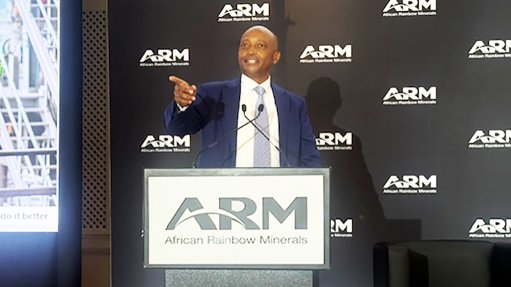
African Rainbow Minerals CEO Phillip Tobias.
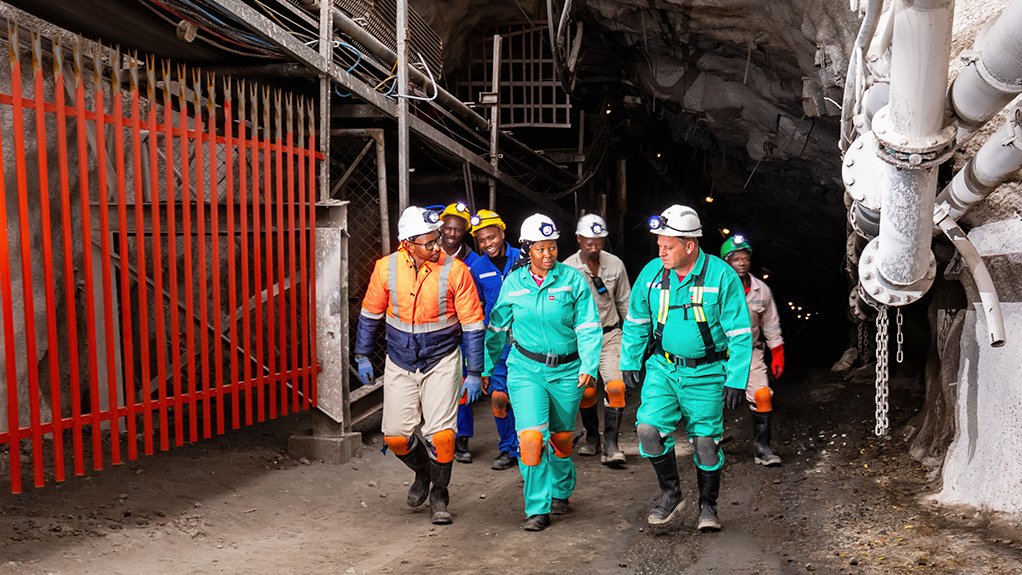
Activity at the Bokoni platinum group metals mine.


JOHANNESBURG (miningweekly.com) – The definitive feasibility study for the Bokoni platinum group metals (PGM) project is targeted for completion in this half of 2026, followed by an investment decision, African Rainbow Minerals (ARM) CEO Phillip Tobias reported during ARM’s latest half-year presentation.
Ore reserve development at Bokoni's Middelpunt Hill shaft is progressing to access high-grade stoping, supporting a ramp-up to 120 000 tonnes per month (tpm) of stoping production.
“We’re still very excited about the quality of the orebody, the grade that it has, and all that it can bring,” Tobias enthused.
An independent value engineering review under way will be followed by a presentation to the board for an investment decision.
For the required narrow-reef-cutting technology, ARM is partnering German tunnel-boring machine company Herrenknecht, and South African reef-boring solutions company Master Drilling of Fochville.
The decline shaft heads directly into upper group two (UG2), the preferred higher-grade reef.
Mining Weekly’s request during question time for an update on the Bokoni project elicited this response: “We’re making good progress. However, there are some teething challenges because the ground where we are is still quite soft, so we’re basically going slowly.
"But in terms of the profile of the excavation that's developing, it really shows that if we sort out those teething issues, it will yield some positive returns. We’re just waiting to see consistent grade performance, so that we can report the positive results.
"We've incorporated lessons that we picked up from Mogalakwena and also from Eland and, as a result, we’re really looking forward to improved performance,” Tobias added.
In response to a question put by Integral Asset Management mining analyst Bruce Williamson about when Bokoni would achieve its targeted 120 000 t steady state, Tobias recalled that Bokoni’s earlier 60 000 t lower-grade effort had proved unviable and that the new way forward was the chosen higher-grade 120 000 tpm throughput level.
ARM COO Jacques van der Bijl's elaboration on the 120 000 tpm throughput decision included the pointing out that most labour-intensive PGM mines have relatively high fixed costs that require minimum ounce production levels to cover those fixed costs and ensure cash competitiveness.
“However, the benefit that Bokoni has is the high in situ grade,” Van der Bijl pointed out
When Bokoni's grades of 6.5 g/t to 7 g/t are fed into the mill, the number of ounces that can be produced – even at the 120 000 tpm level – are very comparable to what is currently being produced at ARM's Two Rivers and Modikwa PGM mines, which have considerbly higher throughput, which, he said, places Bokoni in a "very strong" position to survive the price cycles and be economical over the 20-year lifespan currently being planned for Bokoni. Moreover, the upfront capital required is considerably more moderate.
“We’re in the process of finalising and just doing third party value engineering, and we should be able to provide further clarity at the next reporting session,” Van der Bijl explained.
The UG2 focus carries with it a mineral resource grade 30% higher than Merensky reef and benefits from lower geological losses.
Ore mining and milling operations were suspended at the end of ARM’s 2025 financial year as lower-grade on-reef development, combined with a milling capacity limited to 60 000 t proved insufficient to offset fixed costs and maintain profitability. This decision allows Bokoni to focus capital and strategic efforts on off-reef ore reserve development.
Looking ahead, Bokoni’s future lies in a higher- grade, phased development path. Given the steeper dip of the orebody, the mining method has been revised to a hybrid approach, combining mechanised off-reef development with conventional stoping to maximise ore grade and revenue per tonne while maintaining capital efficiency.
The definitive feasibility study’s capital deployment strategy incorporates the new 120 000 tpm concentrator plant capacity and together with selective use of the existing 60 000 tpm concentrator, enables production to 180 000 tpm.
The narrow-reef-cutting extracts from UG2 reef that is only 70 cm wide and the high PGM grades are contained within that very narrow reef. Tunnelling by the mobile tunnel borer is followed by on-reef cutting. The reef cutting system has been custom designed to suit the UG2 reef layout.
In conventional mining, the typical reef stope height is 120 cm, which introduces additional dilution, resulting in a reduction of the average stoping grades to 6 g/t.
ARM Platinum headline earnings in the six months to December 31 increased by more than 200% to R704-million.
ARM is headed by founder and nonexecutive chairperson Dr Patrice Motsepe.
Article Enquiry
Email Article
Save Article
Feedback
To advertise email advertising@creamermedia.co.za or click here
Research Reports


Projects
Latest Multimedia


Latest News

Showroom

Occupational health services, mobile clinics, wellness campaigns, aviation.
VISIT SHOWROOM
As one of South Africa's leading manufacturers, Bell Equipment distributes and exports its wide range of heavy equipment globally to mining,...
VISIT SHOWROOM
Press Office
Announcements
What's On
Subscribe to improve your user experience...
Option 1 (equivalent of R125 a month):
Receive a weekly copy of Creamer Media's Engineering News & Mining Weekly magazine
(print copy for those in South Africa and e-magazine for those outside of South Africa)
Receive daily email newsletters
Access to full search results
Access archive of magazine back copies
Access to Projects in Progress
Access to ONE Research Report of your choice in PDF format
Option 2 (equivalent of R375 a month):
All benefits from Option 1
PLUS
Access to Creamer Media's Research Channel Africa for ALL Research Reports, in PDF format, on various industrial and mining sectors
including Electricity; Water; Energy Transition; Hydrogen; Roads, Rail and Ports; Coal; Gold; Platinum; Battery Metals; etc.
Already a subscriber?
Forgotten your password?
Receive weekly copy of Creamer Media's Engineering News & Mining Weekly magazine (print copy for those in South Africa and e-magazine for those outside of South Africa)
➕
Recieve daily email newsletters
➕
Access to full search results
➕
Access archive of magazine back copies
➕
Access to Projects in Progress
➕
Access to ONE Research Report of your choice in PDF format
RESEARCH CHANNEL AFRICA
R4500 (equivalent of R375 a month)
SUBSCRIBEAll benefits from Option 1
➕
Access to Creamer Media's Research Channel Africa for ALL Research Reports on various industrial and mining sectors, in PDF format, including on:
Electricity
➕
Water
➕
Energy Transition
➕
Hydrogen
➕
Roads, Rail and Ports
➕
Coal
➕
Gold
➕
Platinum
➕
Battery Metals
➕
etc.
Receive all benefits from Option 1 or Option 2 delivered to numerous people at your company
➕
Multiple User names and Passwords for simultaneous log-ins
➕
Intranet integration access to all in your organisation