Africa urged to leverage critical minerals through partnerships, infrastructure, value addition


Africa urged to leverage critical minerals through partnerships, infrastructure, value addition
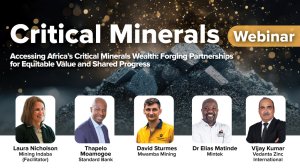



Africa will only capture meaningful economic value from rising global demand for critical minerals if it strengthens partnerships, improves infrastructure, ensures regulatory certainty and expands value-added industrial capacity.
This was the central message from speakers at a webinar on critical minerals held on December 3, hosted by Creamer Media in partnership with the Investing in African Mining Indaba, under the theme Accessing Africa’s Wealth for Shared Progress.
The discussion was chaired by Hyve Group’s Investing in African Mining Indaba product director Laura Nicholson. Vedanta Zinc International deputy CEO Vijay Kumar, Standard Bank metals and mining executive head Thapelo Moamogoe, Mintek pyrometallurgy executive manager Dr Elias Matinde and Mwamba Mining chief sourcing officer David Sturmes made up the rest of the panel.
“Partnerships are not just a concept. They are the foundation for unlocking Africa's mineral wealth responsibly and inclusively. Collaboration between governments, industry investors, technology innovators and communities ensures that mining becomes a catalyst for development rather than a siloed activity,” Nicholson said.
Kumar commented that Africa’s mineral wealth had not translated into broad societal development despite the continent being richly endowed with natural resources. He said the growing global need for critical minerals required a reassessment of how mining could contribute more widely to economic and social outcomes.
“This continent is blessed with lots and lots of resources, but unfortunately, it is also the least developed. We still haven't reaped the real benefits that should go to the broader society because of these rich mineral resources,” Kumar said.
He added that traditional methods of assessing mining projects were insufficient in addressing complex development challenges. He said broader collaboration among governments, investors, communities and technical partners was needed to share risk and expand benefits.
“Looking at some of these complex projects purely from the lens of business net present value is not going to solve the issue. We will have to really evaluate it in a much more collaborative approach,” Kumar said.
He said mining companies could no longer operate as self-contained entities managing entire value chains on their own, because the scale and complexity of modern projects required multiple participants.
He added that community support, investor confidence and government involvement were all essential to avoiding delays and ensuring projects advanced.
He further noted that the sector needed new approaches rather than relying on methods used in previous decades.
“Mining is inherently complex, and we cannot solve it with the same methods we used in the 1970s and 1980s. We will have to develop other methods,” Kumar said.
Moamogoe said mining remained central to global development and was critical to clean energy technologies, emphasising that demand for minerals would shape future industrial growth.
He said mining’s role in the economy continued to be significant and would expand as countries pursued renewable-energy ambitions.
“At the heart of it, mining remains quite critical. It is a sunrise sector,” he said.
Moamogoe highlighted two key constraints facing investors: the reliability of infrastructure and the stability of regulation. He said companies needed certainty that transport networks would allow them to move products efficiently and that policy would be predictable over investment cycles of five to ten years.
Matinde posited that Africa was well positioned to supply the minerals required for both energy transition industries and traditional sectors such as steel, construction materials and industrial manufacturing.
He said these areas remained essential for closing Africa’s infrastructure gap and improving regional competitiveness. He noted that mineral wealth played a similar role today to petroleum resources in the Middle East, offering Africa a potential foundation for industrial expansion.
Matinde said research and development would be essential in unlocking value from the continent’s mineral resources and developing technologies suited to local ore types and economic conditions.
“The most important aspect in research is how to develop fit-for-purpose technologies that will maximise value and unlock economic potential and impact in the communities where the minerals are being extracted,” he said.
Matinde stated that beneficiation at source could create jobs, support industrial clusters and strengthen local economies.
Lastly, Sturmes said artisanal and small-scale mining supported tens of millions of workers across Africa in minerals ranging from gold and gemstones to coal, lead, copper and lithium.
He argued that partnership-driven approaches were needed to address concerns around safety, informality and environmental impact while supporting communities that depended on these activities for livelihoods.
Sturmes said regional cooperation could increase local sourcing of mining inputs and reduce dependence on imported equipment and supplies, noting that industrial capacity could expand if manufacturing and auxiliary services were developed to serve multiple sectors, including mining and construction.
“From a financing perspective, many investors may be less hesitant to invest in auxiliary services if they see a multi-utility benefit – not only serving the mining industry, but also the construction industry or others,” he said.
He added that value-addition needed to be considered both from “mine to port” and “port to mine”, noting that Africa imported many inputs that could be produced regionally.
Throughout the discussion, speakers stressed that Africa’s mineral endowment presented a significant opportunity for long-term economic transformation but required collaborative frameworks, consistent regulatory systems, regionally integrated supply chains and sustained investment in infrastructure and innovation to realise its potential.
Article Enquiry
Email Article
Save Article
Feedback
To advertise email advertising@creamermedia.co.za or click here


Projects
Latest News

Showroom
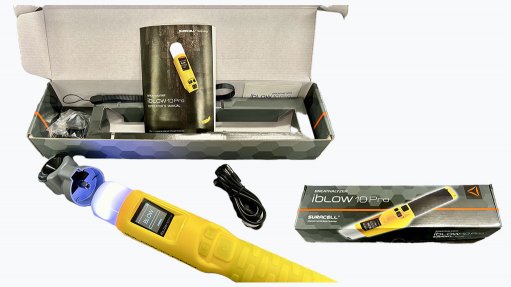
Supplier & Distributor of the Widest Range of Accurate & Easy-to-Use Alcohol Breathalysers
VISIT SHOWROOM
SafeQuip is a leading distributor and manufacturer of fire safety solutions, offering a comprehensive range of products designed to meet all...
VISIT SHOWROOM
Announcements
What's On
Subscribe to improve your user experience...
Option 1 (equivalent of R125 a month):
Receive a weekly copy of Creamer Media's Engineering News & Mining Weekly magazine
(print copy for those in South Africa and e-magazine for those outside of South Africa)
Receive daily email newsletters
Access to full search results
Access archive of magazine back copies
Access to Projects in Progress
Access to ONE Research Report of your choice in PDF format
Option 2 (equivalent of R375 a month):
All benefits from Option 1
PLUS
Access to Creamer Media's Research Channel Africa for ALL Research Reports, in PDF format, on various industrial and mining sectors
including Electricity; Water; Energy Transition; Hydrogen; Roads, Rail and Ports; Coal; Gold; Platinum; Battery Metals; etc.
Already a subscriber?
Forgotten your password?
Receive weekly copy of Creamer Media's Engineering News & Mining Weekly magazine (print copy for those in South Africa and e-magazine for those outside of South Africa)
➕
Recieve daily email newsletters
➕
Access to full search results
➕
Access archive of magazine back copies
➕
Access to Projects in Progress
➕
Access to ONE Research Report of your choice in PDF format
RESEARCH CHANNEL AFRICA
R4500 (equivalent of R375 a month)
SUBSCRIBEAll benefits from Option 1
➕
Access to Creamer Media's Research Channel Africa for ALL Research Reports on various industrial and mining sectors, in PDF format, including on:
Electricity
➕
Water
➕
Energy Transition
➕
Hydrogen
➕
Roads, Rail and Ports
➕
Coal
➕
Gold
➕
Platinum
➕
Battery Metals
➕
etc.
Receive all benefits from Option 1 or Option 2 delivered to numerous people at your company
➕
Multiple User names and Passwords for simultaneous log-ins
➕
Intranet integration access to all in your organisation