‘Deep collaboration’ needed for the deployment of new mining technologies

Panellists discuss opportunities and challenges related to the adoption of new mining technologies in the local sector



As mining companies face increasing pressure to deliver measurable improvements in productivity and safety, while also managing the cost, complexity and risks associated with adopting new technologies, emerging innovations are transforming the industry, driving the deployment of advanced technological solutions across mining operations.
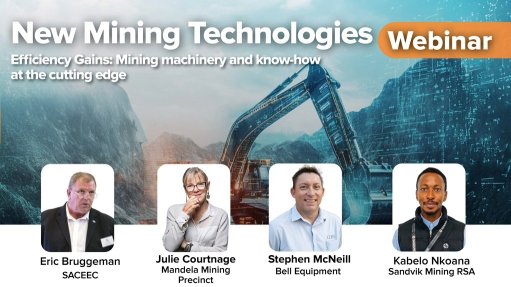
This was the topic discussed during Creamer Media’s Mining Technologies webinar on February 25, facilitated by South African Equipment Export Council CEO Eric Bruggeman.
Panellists – Mandela Mining Precinct executive director Julie Courtnage, Bell Equipment group marketing head Stephen McNeill and Sandvik Mining and Rock Solutions business line manager for automation and digitisation Kabelo Nkoana – discussed how emerging technologies are being deployed in practice and how mining companies can overcome adoption barriers, build a sound investment case and prepare their workforce for technology-driven change.
Courtnage highlighted the importance of collaboration in the development and deployment of new mining technologies, arguing that innovation required information flow.
“Collaboration makes you solve problems quicker. It helps you see risks that you might not perceive if only one person is working on it. It shares information so that there's less duplication and it's much more cost efficient. And with everybody having skin in the game, everybody wins,” she expressed.
Courtnage stressed the importance of innovations such as mechanisation, automation and digitisation, which included, for example, digital twinning, AI and machine learning in improving safety and productivity on mines.
“Because mining is a system of systems, if you have any single one in isolation from the others, to be frank, it won't operate to deliver the value that it can when we plug all of those together in a systems model.”
Nkoana agreed on the importance of combining different technological solutions, but suggested that solutions be gradually introduced to avoid overwhelming mines.
“The best way to do it is to introduce . . . one at a time, so that the mine can easily adapt to these new technologies.”
Nkoana also highlighted an increase in the adoption of AI, primarily in the form of digital monitoring and data analysis, that can allow mines to make quick decisions using the relevant information.
“AI is definitely coming up in a large scale.”
Additionally, McNeill highlighted the issue of managing new technology adoption and emission regulations, as well as the costs associated with the adoption of new technology.
“With technology changing and emission regulations, it doesn't always result in lower cost . . . the trick is making sure that you have the right technology and the highest level of technology, so that you're not throwing massive cost at something that could also take away productivity.
“So your aim is to innovate in such a way, and introduce things in such a way, that you are trying to reduce emissions and trying to improve efficiency,” he said.
Meanwhile, Courtnage also highlighted hurdles when it came to the adoption of new technologies, arguing, for example, that an active management of change could help accelerate technology adoption.
Courtnage also noted the importance of technology and human-readiness levels, as well as “vendor lock-in”.
“Because we've now got AI, we've got real-time information management, we've got safety aspects, we've got environmental monitoring all becoming digitalised, or machine-to-machine learning; if it's not vendor agnostic, the technology would have to be adopted in isolation and that then obviously won't fit into the mining system,” she said, highlighting the importance of also considering market readiness before investing in technology.
“Innovation has to be driven - and technology adoption has to be driven - by solving real problems.”
Looking ahead in terms of innovation in mining, Courtnage emphasised the importance of adopting a people-centric approach that took health and safety into consideration.
She also reiterated the importance of information sharing, as well as linking research, development and innovation with “real on-the-ground problems”.
“That will take very deep collaboration, which takes a lot of relationship building and trust,” she said.
Additionally, Bruggeman agreed on the importance of adopting a people-centric approach.
“We can develop technology, but it's important that we develop it responsibly, so that we are not compromising on jobs and compromising things in the economy that could hurt us. We need to grow responsibly and innovate responsibly,” said Bruggeman.
Article Enquiry
Email Article
Save Article
Feedback
To advertise email advertising@creamermedia.co.za or click here

Projects
Latest Multimedia

Latest News
Showroom

We supply customers with practical affordable solutions for their testing needs. Our products include benchtop, portable, in-line process control...
VISIT SHOWROOM
Supplier & Distributor of the Widest Range of Accurate & Easy-to-Use Alcohol Breathalysers
VISIT SHOWROOM


Announcements
What's On
Subscribe to improve your user experience...
Option 1 (equivalent of R125 a month):
Receive a weekly copy of Creamer Media's Engineering News & Mining Weekly magazine
(print copy for those in South Africa and e-magazine for those outside of South Africa)
Receive daily email newsletters
Access to full search results
Access archive of magazine back copies
Access to Projects in Progress
Access to ONE Research Report of your choice in PDF format
Option 2 (equivalent of R375 a month):
All benefits from Option 1
PLUS
Access to Creamer Media's Research Channel Africa for ALL Research Reports, in PDF format, on various industrial and mining sectors
including Electricity; Water; Energy Transition; Hydrogen; Roads, Rail and Ports; Coal; Gold; Platinum; Battery Metals; etc.
Already a subscriber?
Forgotten your password?
Receive weekly copy of Creamer Media's Engineering News & Mining Weekly magazine (print copy for those in South Africa and e-magazine for those outside of South Africa)
➕
Recieve daily email newsletters
➕
Access to full search results
➕
Access archive of magazine back copies
➕
Access to Projects in Progress
➕
Access to ONE Research Report of your choice in PDF format
RESEARCH CHANNEL AFRICA
R4500 (equivalent of R375 a month)
SUBSCRIBEAll benefits from Option 1
➕
Access to Creamer Media's Research Channel Africa for ALL Research Reports on various industrial and mining sectors, in PDF format, including on:
Electricity
➕
Water
➕
Energy Transition
➕
Hydrogen
➕
Roads, Rail and Ports
➕
Coal
➕
Gold
➕
Platinum
➕
Battery Metals
➕
etc.
Receive all benefits from Option 1 or Option 2 delivered to numerous people at your company
➕
Multiple User names and Passwords for simultaneous log-ins
➕
Intranet integration access to all in your organisation