Collaborative reconstruction tests vehicle AI systems

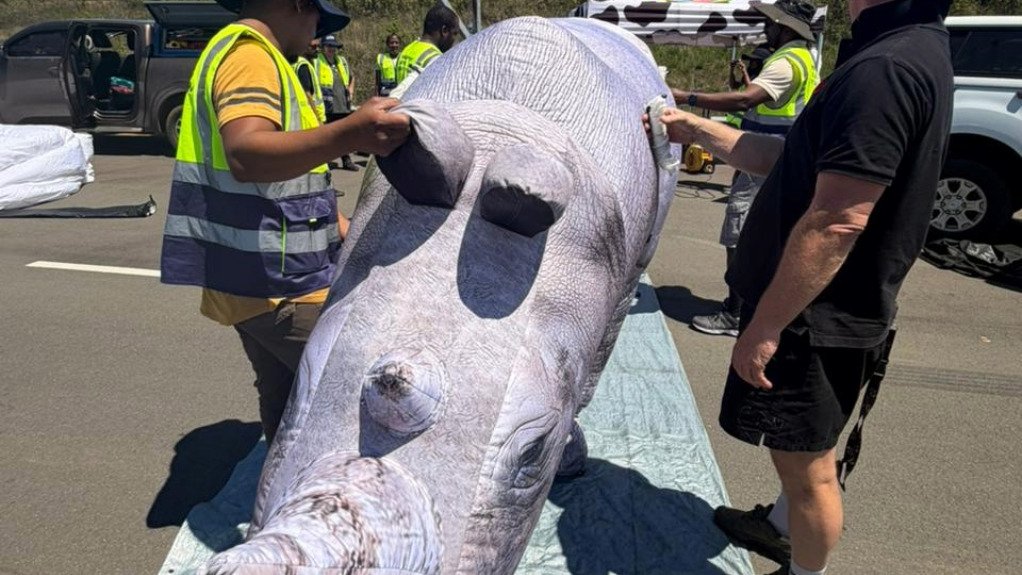
COLLISION TESTING To simulate real-work conditions, such as vehicles colliding with animals or pedestrians, the team from SMART Lab, Accident Specialist and CSIR made use of inflatable pedestrian dummies and a blow-up rhino, testing vehicles from Toyota and other vehicle manufacturers, including Lexus and GWM
Photo by UKZN
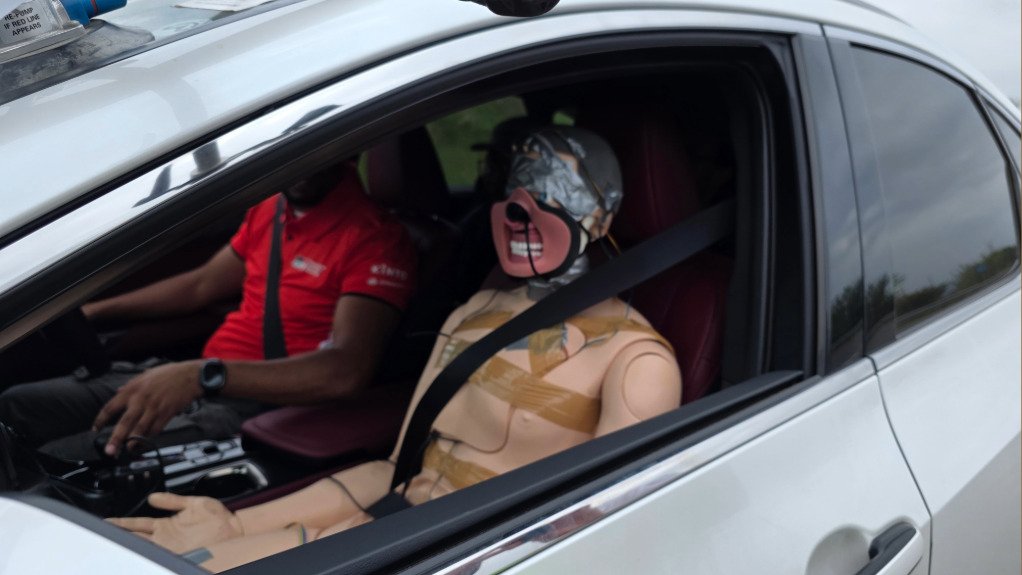
DATA COLLECTION The test session, held at Toyota’s Eston test Track, conducted the tests through the use of dummies that were equipped with accelerometers and gyroscopes to record whiplash and body motion
Photo by UKZN


Tertiary education institute the University of KwaZulu-Natal’s (UKZN’s) Scientific Multidisciplinary Advanced Research Technologies (SMART) Lab participated in a series of collaborative crash reconstruction tests, in an initiative undertaken as a part of ongoing research into vehicle dynamics, safety and advanced driver assistance systems (ADAS).
The tests were conducted at vehicle manufacturer Toyota’s Eston test track, in Durban, South Africa.
In collaboration with forensic consultant Accident Specialist CEO Craig Proctor-Parker, UKZN SMART Lab’s Professor Riaan Stopforth says the results – after many tests and validation – will be used in publications as evidence for court cases and for public awareness.
The test session held at Eston included researchers from the Council for Scientific and Industrial Research’s Transport Safety team, who conducted the tests using dummies that were equipped with accelerometers and gyroscopes to record whiplash and body motion.
“These results give a good indication of the impact that sudden braking could have on a person,” Stopforth states. Other experiments explored lane-change dynamics, measuring lateral acceleration and distance requirements at different speeds. The results provided valuable data for comparing theoretical models with real-world performance, highlighting significant differences between simulation outcomes and live testing.
While some of the tests that have and will be conducted this year can be considered very simplistic, with theoretical equations already available, there is value in exploring the practical aspects of these theoretical equations, particularly as technology has advanced, Stopforth notes.
The main focus of the tests was to evaluate ADAS technologies – which are AI-driven systems that are designed to detect pedestrians, animals, obstacles and other vehicles.
As such, different vehicles were considered – from trucks down to sedans – as many factors, such as the size, colour and density of the object, had to be considered.
The team conducted trials using inflatable pedestrian dummies and a blow-up rhino to simulate real-world conditions, such as vehicles colliding with animals or pedestrians, testing vehicles from Toyota and other vehicle manufacturers, including Lexus and GWM.
The first challenge was buy-in from the manufacturers, as many of them did not want their vehicles to be tested by third parties, and while companies would initially agree to participate, they would often withdraw days before the tests occurred.
Having eventually secured test vehicles, the next challenge was data-related: “Once the data is recorded, there are thousands of numbers that need to be analysed. We had to correlate the data recorded with the GPS timestamp, and with that of the different instruments,” Proctor-Parker adds.
This was followed by the data being plotted, and the use of different critical points to identify specific results and/or outcomes. The tests were then repeated, and often redone entirely, as a sudden braking could cause the sensor to disconnect from the power source, resulting in incomplete recordings.
Additionally, poor weather could cause inappropriate or inaccurate GPS recording, resulting in degenerative predictive network or graph neural network readings, necessitating that testers ensure that equipment was properly secured and that all sensors were connected.
Stopforth notes that assistance from the vehicles’ and the ADAS’s original- equipment manufacturers was critical. The trials ultimately showed that, while AI systems have advanced significantly, human oversight remains essential to ensure safety.
AI Intervention
UKZN SMART Labs and Accident Specialist also added accelerometers, gyroscopes and 360º cameras in the vehicles – as well as GoPro cameras outside them – to monitor the motion of the dummies representing the driver and other occupants.
Although the AI is a tool for driving, it is also meant to actually intervene, such as for braking, as part of the onboard ADAS.
“The problem with AI in a vehicle is that, should there be an accident, who will be responsible for the accident? The vehicle manufacturer, the owner of the vehicle or the driver? Essentially it is the driver,” Proctor-Parker adds.
Stopforth says AI technologies enable drivers to be aware of possible collisions, especially on busy roads, but the driver must react to this information rather than relying completely on the AI to act.
He states that once all the tests have been performed, UKZN SMART Lab and Accident Specialist will create new models to be used for accident investigations in the future.
“The higher the frequency and accuracy of the data recorded, the higher the accuracy in the models and analysis. There will always be errors, but we need to identify the types of error, and the margin for error, and whether this is acceptable,” Proctor-Parker states.
However, he cautions that because AI models use what they observe, these models could also absorb inaccurate data and create inaccurate models.
Article Enquiry
Email Article
Save Article
Feedback
To advertise email advertising@creamermedia.co.za or click here
Research Reports


Projects

Latest Multimedia


Latest News


Showroom

For over 15 years, Lilak Aluminium, a trusted leader in architectural extrusion supply, has delivered excellence to businesses like yours.
VISIT SHOWROOM
Leading condition monitoring specialists, WearCheck, help boost machinery lifespan and reduce catastrophic component failure through the scientific...
VISIT SHOWROOM
Announcements
What's On
Subscribe to improve your user experience...
Option 1 (equivalent of R125 a month):
Receive a weekly copy of Creamer Media's Engineering News & Mining Weekly magazine
(print copy for those in South Africa and e-magazine for those outside of South Africa)
Receive daily email newsletters
Access to full search results
Access archive of magazine back copies
Access to Projects in Progress
Access to ONE Research Report of your choice in PDF format
Option 2 (equivalent of R375 a month):
All benefits from Option 1
PLUS
Access to Creamer Media's Research Channel Africa for ALL Research Reports, in PDF format, on various industrial and mining sectors
including Electricity; Water; Energy Transition; Hydrogen; Roads, Rail and Ports; Coal; Gold; Platinum; Battery Metals; etc.
Already a subscriber?
Forgotten your password?
Receive weekly copy of Creamer Media's Engineering News & Mining Weekly magazine (print copy for those in South Africa and e-magazine for those outside of South Africa)
➕
Recieve daily email newsletters
➕
Access to full search results
➕
Access archive of magazine back copies
➕
Access to Projects in Progress
➕
Access to ONE Research Report of your choice in PDF format
RESEARCH CHANNEL AFRICA
R4500 (equivalent of R375 a month)
SUBSCRIBEAll benefits from Option 1
➕
Access to Creamer Media's Research Channel Africa for ALL Research Reports on various industrial and mining sectors, in PDF format, including on:
Electricity
➕
Water
➕
Energy Transition
➕
Hydrogen
➕
Roads, Rail and Ports
➕
Coal
➕
Gold
➕
Platinum
➕
Battery Metals
➕
etc.
Receive all benefits from Option 1 or Option 2 delivered to numerous people at your company
➕
Multiple User names and Passwords for simultaneous log-ins
➕
Intranet integration access to all in your organisation