Harassment risk in mining sector nearly twice the national average – report

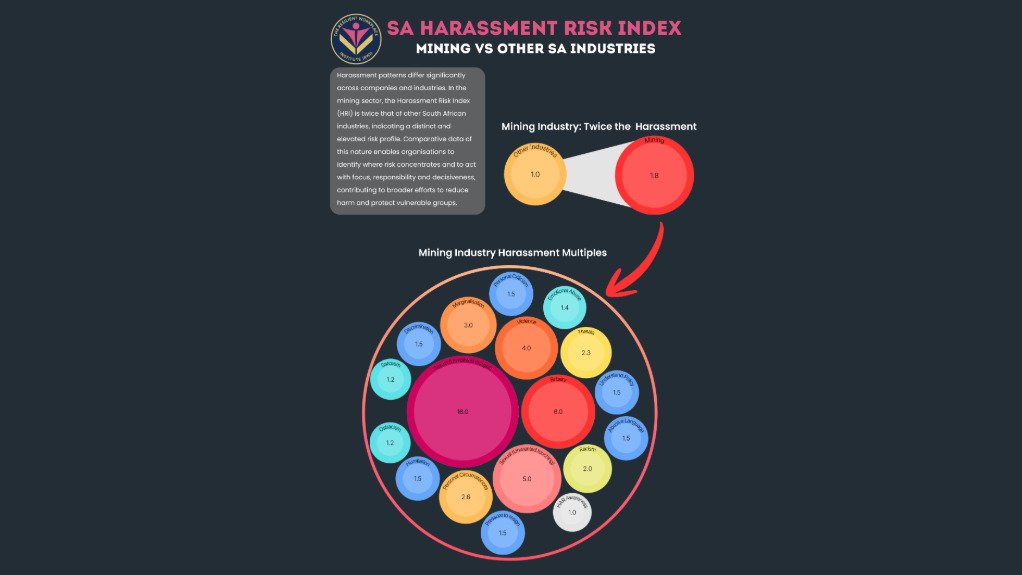


New benchmarking data comparing the South African mining sector to other industries reveals a stark and largely hidden risk profile: harassment risk in mining is almost twice the national average, with severe gender based violence- (GBV-) related behaviours occurring at far higher intensity than elsewhere in the economy, according to nonprofit organisation (NPO) the Resilient Workplace Institute.
The NPO notes, in a media release, that the Harassment Risk Assessment (HRA) data aggregated across mining operations shows an overall harassment risk index (HRI) of 3.36, compared with 1.82 for the broader South African workforce.
The Resilient Workplace Institute argues that this confirms that harassment does not manifest uniformly across sectors and that mining presents a distinct people-risk landscape.
“Importantly, the findings challenge common assumptions about what harassment in mining looks like. While sexual harassment ranks among the bottom three categories in both mining and other industries, severity tells a very different story,” it explains.
The NPO posits that, in mining, unwanted touching occurs at six times the rate, and unwanted sexual images at 16 times the rate, compared with other sectors.
“These extreme multiples suggest that serious behaviours can remain obscured when organisations rely only on grievance data or surface indicators.”
The data also shows that the most prevalent forms of harassment in mining are not headline violations, but everyday behaviours, such as threats, discrimination, personal circumstances used to put employees under pressure, and violence.
“These behaviours steadily erode trust, silence reporting, and undermine psychological safety – conditions increasingly recognised as precursors to safety incidents and operational failures”.
Viewed through a GBV lens, the Resilient Workplace Institute notes that the findings reveal further complexity.
While women remain disproportionately affected by certain GBV-related behaviours, men in mining report exposure across a wider range of harassment types than women, when benchmarked against the national index, the NPO points out.
The organisation argues that this pattern challenges simplified narratives that frame harassment risk solely along gender lines and highlights how power dynamics and work environments in male-dominated sectors shape exposure differently.
Another unexpected insight is how harassment risk clusters at specific occupational and organisational levels, rather than being evenly distributed across the workforce.
“Exposure does not always align with where risk is traditionally assumed to sit, raising important questions about supervision layers, team cultures and progression pathways within mining operations,” says the Resilient Workplace Institute.
The NPO says these findings align closely with guidance from the Mine Health and Safety Council, which recognises psychosocial hazards – including harassment and violence – as risks that can undermine safety, health and operational performance.
In this context, the organisation argues that harassment and GBV should not be seen as isolated human resources concerns, but as leading indicators of culture breakdown, often appearing well before incidents, grievances, productivity losses or attrition.
With GBV officially recognised as a national disaster in South Africa, the NPO says the role of corporates in addressing workplace contributors to societal harm has come under renewed scrutiny.
“The mining data suggests that without proper measurement, organisations risk underestimating both the scale and severity of harassment exposure and missing early warning signals that matter for safety, productivity and governance.
“Ultimately, the value of this benchmarking lies not in comparison for its own sake, but in the visibility it provides. Data enables mining leaders to see where risk concentrates, intervene earlier, and treat culture with the same seriousness as other enterprise risks.”
The Resilient Workplace Institute highlights that sexual harassment consistently ranks among the bottom five risks across all companies assessed, despite the broader GBV crisis in the macro environment.
The organisation says this lower relative ranking reflects the effectiveness of company governance, internal controls, and sustained management attention following the introduction of South Africa’s 2005 Code of Good Practice on the Handling of Sexual Harassment Cases in the Workplace, which was replaced in 2022 by the Code of Good Practice on the Prevention and Elimination of Harassment in the Workplace.
“Nearly two decades of policy development, training, reporting procedures and awareness initiatives have contributed to lower measured risk levels relative to other forms of harassment, demonstrating that governance frameworks and controls contribute towards reduction of risk,” the NPO says.
Article Enquiry
Email Article
Save Article
Feedback
To advertise email advertising@creamermedia.co.za or click here

Projects
Latest Multimedia

Latest News
Showroom

CMTS is a leading, well-established EC&I contractor with 37+ years of mining and industrial experience. We execute full-scope EC&I projects with...
VISIT SHOWROOM
REELIN is Currently the largest supplier of Bearings to Transnet. We have contracts to supply bearings, draft gears slackadjusters and other...
VISIT SHOWROOM


Announcements
What's On
Subscribe to improve your user experience...
Option 1 (equivalent of R125 a month):
Receive a weekly copy of Creamer Media's Engineering News & Mining Weekly magazine
(print copy for those in South Africa and e-magazine for those outside of South Africa)
Receive daily email newsletters
Access to full search results
Access archive of magazine back copies
Access to Projects in Progress
Access to ONE Research Report of your choice in PDF format
Option 2 (equivalent of R375 a month):
All benefits from Option 1
PLUS
Access to Creamer Media's Research Channel Africa for ALL Research Reports, in PDF format, on various industrial and mining sectors
including Electricity; Water; Energy Transition; Hydrogen; Roads, Rail and Ports; Coal; Gold; Platinum; Battery Metals; etc.
Already a subscriber?
Forgotten your password?
Receive weekly copy of Creamer Media's Engineering News & Mining Weekly magazine (print copy for those in South Africa and e-magazine for those outside of South Africa)
➕
Recieve daily email newsletters
➕
Access to full search results
➕
Access archive of magazine back copies
➕
Access to Projects in Progress
➕
Access to ONE Research Report of your choice in PDF format
RESEARCH CHANNEL AFRICA
R4500 (equivalent of R375 a month)
SUBSCRIBEAll benefits from Option 1
➕
Access to Creamer Media's Research Channel Africa for ALL Research Reports on various industrial and mining sectors, in PDF format, including on:
Electricity
➕
Water
➕
Energy Transition
➕
Hydrogen
➕
Roads, Rail and Ports
➕
Coal
➕
Gold
➕
Platinum
➕
Battery Metals
➕
etc.
Receive all benefits from Option 1 or Option 2 delivered to numerous people at your company
➕
Multiple User names and Passwords for simultaneous log-ins
➕
Intranet integration access to all in your organisation