Iron-ore output growth on the horizon for BHP in Australia, Brazil

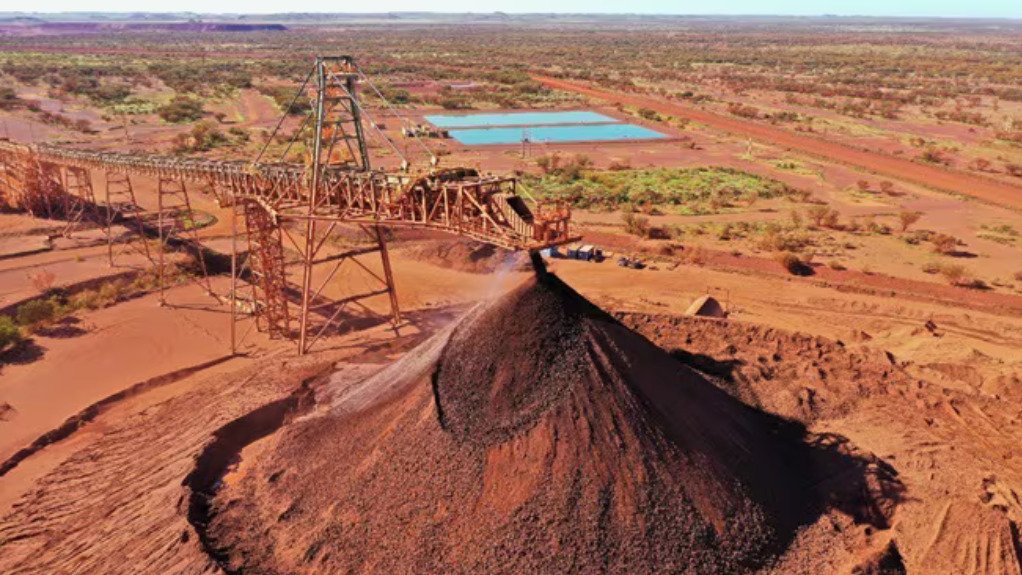


As the world’s lowest-cost major iron-ore producer globally, iron-ore remains a cornerstone of diversified miner BHP’s production portfolio and earnings.
The group produced 134-million tonnes of iron-ore in the six months ended December 31, 2025, which marked a 2% year-on-year increase.
BHP maintains its iron-ore guidance at between 258-million and 269-million tonnes of iron-ore for the full financial year to June 30.
The company reported an average realised price of $84.71/t, which was 4% higher year-on-year. This contributed to a 4% year-on-year increase in underlying earnings before interest, taxes, depreciation and amortisation (Ebitda) to $7.5-billion for the iron-ore segment.
Iron-ore contributed 48% to the group’s underlying Ebitda.
BHP spent $1.6-billion on capital and exploration for iron-ore in the half-year under review.
CEO Mike Henry says iron-ore demand in China remains resilient, with the country’s steel production estimated to have reached one-billion tonnes again in 2025 for the seventh consecutive year.
He adds that strong steel demand in China’s automotive and machinery sectors helped to offset ongoing structural weakness in the country’s real estate sector, which Henry expects to persist through the remainder of the 2026 financial year.
Iron-ore demand in the rest of the world was mixed in the period under review – demand from India and emerging Asian economies continued to grow alongside new blast furnace capacity additions, while demand in mature markets was subdued.
Looking ahead, Henry anticipates global iron-ore and steel demand to remain broadly stable in the short term, with rising trade protectionism remaining a risk to demand.
Rising trade protectionism will, however, result in higher costs and trade re-routing rather than demand destruction, Henry pointed out.
Seaborne iron-ore demand is expected to plateau at the current high level over the next few years, with slight reductions in China offset by growth from emerging economies and a mild recovery from Europe – driven by the Carbon Border Adjustment Mechanism.
Seaborne iron-ore supply, on the other hand, is expected to increase, with major mining companies’ established production bases showing modest growth, alongside the new supply from Guinea. Rising Indian domestic demand is expected to act as a constraint on its iron-ore exports going forward.
“Our estimate of cost support continues to sit in the $80/t to 100/t range. China’s steel production will plateau around the one-billion-tonne level in the late 2020s. Chinese pig iron production is expected to decline mildly over this period as less iron-ore is displaced by scrap than previously expected,” BHP states.
A critical source of scrap is the property sector where sectoral weakness in China is constraining scrap generation. In the long run, the seaborne iron-ore trade is likely to undergo steady diversification as demand grows in emerging economies, BHP states.
Meanwhile, BHP remains the lowest cost major iron-ore producer globally owing to a focus on cost position at the Western Australia Iron Ore (WAIO) operations, in Australia.
The operations comprise five mines, four processing hubs and more than 1 000 km of rail connecting to ports.
In the six months under review, BHP completed the Car Dumper 3 renewal project ahead of schedule and started execution on the sixth car dumper project, while the Western Ridge Crusher project is on track for completion in the first quarter of the 2027 financial year.
Henry explains that these projects have created resilience and reliability across BHP’s iron-ore operations.
BHP plans to increase production to more than 305-million tonnes of iron-ore a year by the end of the 2028 financial year and sustain it over the medium term.
Unit costs will likely decrease to about $17.50/t at the WAIO operations.
Meanwhile, BHP entered into an agreement with fellow mining major Rio Tinto to explore opportunities to mine up to 200-million tonnes of iron-ore from the companies’ shared tenure boundary in Australia between BHP’s Yandi and Rio Tinto’s Yandicoogina mines that was previously inaccessible.
Subject to approvals and a final investment decision, first ore from this endeavour is expected early in the 2030s.
In Brazil, the Samarco board approved the Phase 3 concentrator project in the period under review. BHP is a 50% shareholder in the Samarco Mineração joint venture in Brazil, alongside Vale, but the Samarco iron-ore mine remains independently operated by Samarco.
Samarco will invest $2.4-billion to lift production capacity to about 26-million tonnes a year through staged recommissioning of remaining latent capacity in the concentrator and pelletising plant infrastructure across the 2028 and 2029 calendar years.
For context, Samarco produced four-million tonnes of iron-ore in the half-year under review, as a result of stronger performance at the second concentrator following ramp-up, as well as higher feed grades and recoveries.
Article Enquiry
Email Article
Save Article
Feedback
To advertise email advertising@creamermedia.co.za or click here
Research Reports

Projects
Latest Multimedia


Latest News
Showroom
CSIR International Convention Centre (CSIR ICC) - the leading conference and events venue in Pretoria/Tshwane.
VISIT SHOWROOM
For over 15 years, Lilak Aluminium, a trusted leader in architectural extrusion supply, has delivered excellence to businesses like yours.
VISIT SHOWROOM
Announcements
What's On
Subscribe to improve your user experience...
Option 1 (equivalent of R125 a month):
Receive a weekly copy of Creamer Media's Engineering News & Mining Weekly magazine
(print copy for those in South Africa and e-magazine for those outside of South Africa)
Receive daily email newsletters
Access to full search results
Access archive of magazine back copies
Access to Projects in Progress
Access to ONE Research Report of your choice in PDF format
Option 2 (equivalent of R375 a month):
All benefits from Option 1
PLUS
Access to Creamer Media's Research Channel Africa for ALL Research Reports, in PDF format, on various industrial and mining sectors
including Electricity; Water; Energy Transition; Hydrogen; Roads, Rail and Ports; Coal; Gold; Platinum; Battery Metals; etc.
Already a subscriber?
Forgotten your password?
Receive weekly copy of Creamer Media's Engineering News & Mining Weekly magazine (print copy for those in South Africa and e-magazine for those outside of South Africa)
➕
Recieve daily email newsletters
➕
Access to full search results
➕
Access archive of magazine back copies
➕
Access to Projects in Progress
➕
Access to ONE Research Report of your choice in PDF format
RESEARCH CHANNEL AFRICA
R4500 (equivalent of R375 a month)
SUBSCRIBEAll benefits from Option 1
➕
Access to Creamer Media's Research Channel Africa for ALL Research Reports on various industrial and mining sectors, in PDF format, including on:
Electricity
➕
Water
➕
Energy Transition
➕
Hydrogen
➕
Roads, Rail and Ports
➕
Coal
➕
Gold
➕
Platinum
➕
Battery Metals
➕
etc.
Receive all benefits from Option 1 or Option 2 delivered to numerous people at your company
➕
Multiple User names and Passwords for simultaneous log-ins
➕
Intranet integration access to all in your organisation