Legendary Brian Gilbertson’s colossal contribution to mining will live on

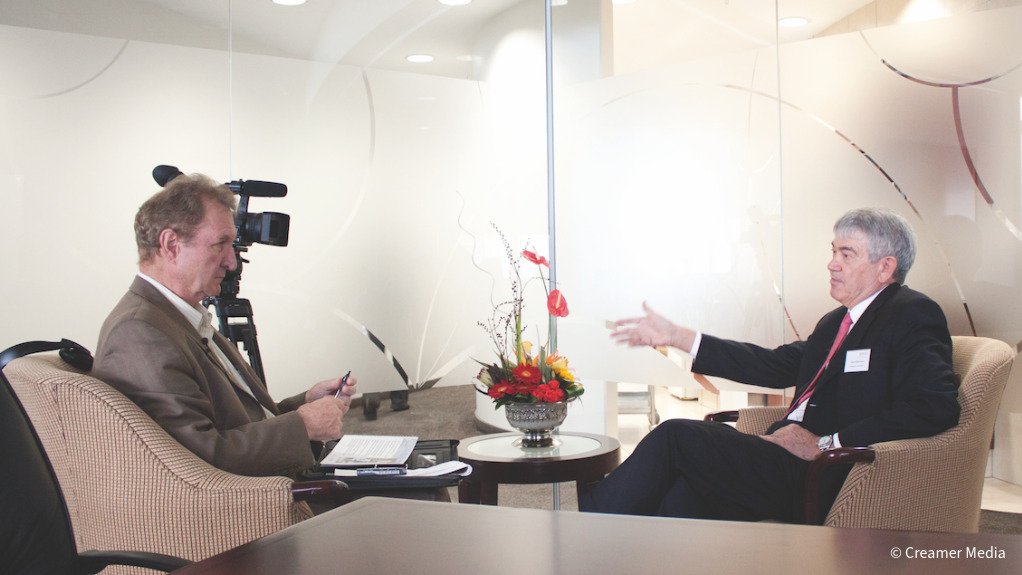
Flashback to Brian Gilbertson (right) being interviewed by Mining Weekly editor Martin Creamer.
Photo by Creamer Media


JOHANNESBURG (miningweekly.com) – It is difficult to know where to start when doing an obituary on mining luminary Brian Gilbertson, who passed away at the age of 82 in his bed at home in South Africa surrounded by family on Wednesday, December 17, after a long period of illness.
His legendary lifetime of leadership had him hallowed in the South African Mining Hall of Fame and presented the Brigadier Stokes Memorial Award of the South African Institute of Mining and Metallurgy for his “outstanding and unique contribution to the South African Mining Industry over a long period”.
But his solid rockface efforts at the likes of Rustenburg Platinum, Gencor, Billiton, BHP Billiton, Rusal, Vedanta and Pallinghurst helped to elevate him sky-high as a mining industry great, who is survived by his wife Rensche (nee Fouché), whom he married in 1970; sons Quinton and Sean; daughters-in-law Ruth and Daniella; and five grandchildren.
Born on August 15, 1943, in George, South Africa, Gilbertson spent his formative schooling years in Bothaville.
In 1960, the Council for Scientific and Industrial Research (CSIR) awarded him a bursary to study at Rhodes University where, in 1963, he obtained a BSc degree, majoring in mathematics and physics.
The following year he earned a BSc (Hons) in physics. Following further study (part-time), he was awarded an MSc in physics by Rhodes University in 1969 and a Master of Business Leadership by the University of South Africa in 1973. In 1983, he attended PMD45 at Harvard University.
Bursary obligations saw Gilbertson join the National Institute for Defence Research of the CSIR in 1965. After a year in Paris, he experimented in applying multispectral pattern recognition to missile guidance and proximity detection (Cactus/Crotale SAM).
The opportunity to test the technique in mineral exploration prompted him to join one of South Africa’s major mining houses, the Johannesburg Consolidated Investment Company (JCI) in 1970. Pioneering work in this field led to his appointment in 1973 as principal investigator for the American Space Agency, NASA, on the ERTS-1 project.
In 1975, Gilbertson moved to the JCI head office. Over time, he assumed increasing responsibilities within Rustenburg Platinum Mines (RPM), which over this period gained recognition as the world’s foremost producer of platinum. In 1986, he was appointed a main board director of JCI and, simultaneously, MD of RPM.
In 1988, in a surprise move, Gilbertson left JCI to work as executive director of Gencor, the South African mining company formed in 1980 after the merger of the General Mining and Finance Corporation and the Union Corporation – parts of which are now owned by Gold Fields, South 32 and BHP.
His first task, Mining Weekly can report, was to resurrect Gencor’s ailing coal arm, Trans-Natal Limited, which subsequently evolved into the world’s premier steam coal exporter.
In 1989, Gencor formed Genmin to house its mining interests and Gilbertson’s appointment as deputy chair made him responsible for the group’s substantial but declining gold interests. Analysts subsequently commended the restructuring and improved performance of these mines.
In 1990, he was appointed to lead Genmin, adding Samancor, the manganese and chrome producer, and Impala, the platinum producer. That same year, he also became a member of what is today Minerals Council South Africa.
Unusually for a mining person, he was also appointed to serve on the board of the South African Reserve Bank from 1992, the year in which he became executive chairperson of Gencor. The Mining Weekly team witnessed how he skillfully transformed Gencor into a focused minerals and mining group, with the industrial and financial interests being unbundled to shareholders.
Large new capital investments, including the mega Columbus Stainless Steel and the Hillside Aluminium Smelter investments, were also implemented.
Then Gencor’s thrust into the international arena, through the barriers of South Africa’s exchange controls, was spearheaded by a $1.2-billion purchase of the international mining interests – the Billiton assets – of the Royal Dutch/Shell group in 1994.
In July 1997, Gencor sold its nonprecious metals interests to a new London-domiciled corporation, named Billiton Plc, to reflect the historical origins. An ideally timed initial public offering (IPO) raised $1.5-billion and took Billiton into the FTSE100.
A consequent but independent initiative led to the announcement in October 1997 of the merger of the gold operations of Gencor and Gold Fields of South Africa, creating Gold Fields Limited, where Gilbertson served as its first chairperson until October 7, 1998.
In the years following its London listing, Billiton acquired the Mozal aluminium smelter in Mozambique, the Worsley alumina plant and Rio Algom.
On July 1, 2001, Billiton merged – at a premium for its shareholders and through a dual-listed company structure – with Australia’s BHP to create the world’s premier resource company. The integration process was widely recognised as rapid and successful. Gilbertson became the second chief executive of BHP Billiton on July 1, 2002, but resigned six months later. A joint media release cited “irreconcilable differences”.
From May 2003, he served as an advisor to the board of Lonmin, a UK-listed South African platinum producer, and undertook strategic change.
Flowing from this, he initiated the formation, in September 2004, of Incwala Resources, a pioneering black economic-empowerment initiative, and was chairperson until March 2006.
In late 2003, he led mining group Vedanta Resources to the first primary listing of an Indian company on the LSE in the second-largest IPO of the year, raising $876-million. He chaired Vedanta until July 2004.
In August 2004, he joined SUAL, the smaller of Russia’s two aluminium producers, as president.
In March 2007, he led the company into a merger with Rusal, the larger Russian aluminium producer, and the Glencor alumina division, creating consolidated aluminium firmness.
In 2006, Gilbertson established Pallinghurst Resources, a specialist investment vehicle in the natural resources sector which he chaired until March 2021. He took the name Pallinghurst from the tree-lined street near his former home in Westcliff, Johannesburg.
Pallinghurst made three principal investments: in Sedibelo, a platinum deposit north of Pilanesberg, the Tshipi manganese mine in South Africa’s Northern Cape, through Jupiter Mines of Australia, and Gemfields/Fabergé which became the world’s largest miner of emeralds and rubies, which is headed by Sean Gilbertson, Brian Gilbertson’s eldest son.
Brian Gilbertson’s awards include Communicator of the Year in 1991; the Business Times’s Businessperson of the Year in 1994; the Witwatersrand Business School Management Excellence Award in 1996 for “consistently demonstrating high levels of leadership”; and, in 1997, the Frans du Toit Medal from the South African Academy for Science and Art for his “creative contribution to the South African economy”.
Business Day awarded him its Business Achievement Award, “acknowledging Gencor’s single-minded strategy to become a world-class natural resources group”.
In 1998, he was awarded a gold medal by the Institution of Mining and Metallurgy of London for “distinguished services to the international minerals industry”.
The University of the Free State conferred an honorary Doctor Commercii in 2001, and Rhodes University an honorary Doctor of Law in 2004.
Gilbertson was an enthusiastic cyclist and sought relaxation from classical music, reading and cinema.
RECOLLECTIONS
Pallinghurst Group managing partner and co-founder Arne Frandsen recalls that with the formation of Pallinghurst in 2006, Gilbertson took a very firm early stance on mine health and safety, fatalities and lost-time injuries (LTIs).
“We decided then that you cannot have people go to work and some of them get harmed and some of them don't come home. That was simply not okay. When we put Sedibelo together, it was clearly under a zero tolerance for LTIs and fatalities.
"Then also on the energy front, it has all been about trying to be efficient in the way that we use energy. The Kell process is a very good example of that. We have invested in Kell since 2012. So, for years we’ve been investing in a technology that can use a fraction of the electricity being used in beneficiating and smelting of PGMs,” Fransen recalls.
Although BHP is a giant today, Mining Weekly can recall that before Gilbertson turned it into BHP Billiton, in the 1990s, BHP was doing so badly that its BHP acronym was downgraded to 'Broken Hearted People'.
Also, Peter Thompson, co-author of The Big Fella: The Rise and Rise of BHP Billiton, points out that after being appointed BHP Billiton CE in Melbourne, Gilbertson’s first move was to approach Sir Robert Wilson, the chair of Rio Tinto, to merge the two mining titans. When presented with the agreed headline terms, the then BHP Billiton chairperson Don Argus was riled by the idea that the combined group would be London-based and, therefore, no longer ‘The Big Australian'. Argus objected to having been excluded from the talks and, on January 4, 2003, Gilbertson resigned following a BHP Billion board meeting from which he had been excluded. His sudden departure from the helm of BHP Billion remains one of the most controversial incidents in Australia's corporate history.
Article Enquiry
Email Article
Save Article
Feedback
To advertise email advertising@creamermedia.co.za or click here
Research Reports

Projects
Latest Multimedia
Latest News
Showroom
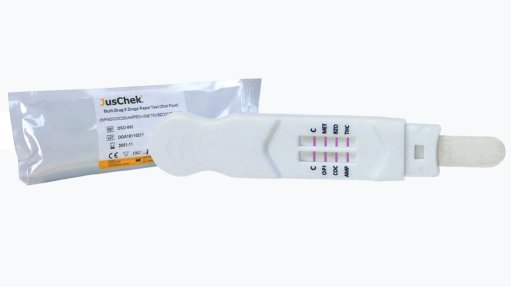
Developed to exceed the latest EN 15964 standards for police breathalysers proving that it will remain accurate and reliable for many years to come.
VISIT SHOWROOM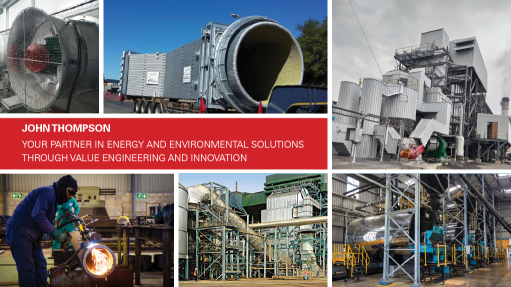
John Thompson, the leader in energy and environmental solutions through value engineering and innovation, provides the following: design, engineer,...
VISIT SHOWROOM
Announcements
What's On
Subscribe to improve your user experience...
Option 1 (equivalent of R125 a month):
Receive a weekly copy of Creamer Media's Engineering News & Mining Weekly magazine
(print copy for those in South Africa and e-magazine for those outside of South Africa)
Receive daily email newsletters
Access to full search results
Access archive of magazine back copies
Access to Projects in Progress
Access to ONE Research Report of your choice in PDF format
Option 2 (equivalent of R375 a month):
All benefits from Option 1
PLUS
Access to Creamer Media's Research Channel Africa for ALL Research Reports, in PDF format, on various industrial and mining sectors
including Electricity; Water; Energy Transition; Hydrogen; Roads, Rail and Ports; Coal; Gold; Platinum; Battery Metals; etc.
Already a subscriber?
Forgotten your password?
Receive weekly copy of Creamer Media's Engineering News & Mining Weekly magazine (print copy for those in South Africa and e-magazine for those outside of South Africa)
➕
Recieve daily email newsletters
➕
Access to full search results
➕
Access archive of magazine back copies
➕
Access to Projects in Progress
➕
Access to ONE Research Report of your choice in PDF format
RESEARCH CHANNEL AFRICA
R4500 (equivalent of R375 a month)
SUBSCRIBEAll benefits from Option 1
➕
Access to Creamer Media's Research Channel Africa for ALL Research Reports on various industrial and mining sectors, in PDF format, including on:
Electricity
➕
Water
➕
Energy Transition
➕
Hydrogen
➕
Roads, Rail and Ports
➕
Coal
➕
Gold
➕
Platinum
➕
Battery Metals
➕
etc.
Receive all benefits from Option 1 or Option 2 delivered to numerous people at your company
➕
Multiple User names and Passwords for simultaneous log-ins
➕
Intranet integration access to all in your organisation