Lithium demand could exceed 13Mt by 2050 – WoodMac

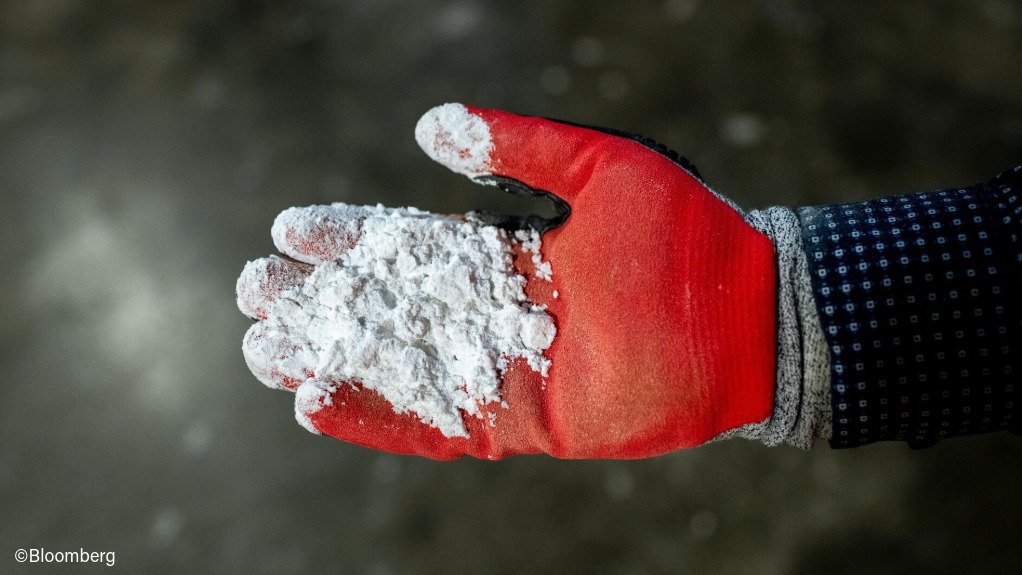



Global lithium demand could exceed 13-million tonnes by 2050 under an accelerated energy transition, more than double base case projections, according to consultancy Wood Mackenzie’s (WoodMac’s) latest ‘Energy Transition Outlook for Lithium’ report.
Without significant new investment, WoodMac warns that supply deficits could emerge as early as 2028.
Even under the base case scenario, the firm says existing supply projects are unlikely to meet demand beyond the mid-2030s, highlighting the need for sustained investment across the value chain.
“The lithium market is heading into a supply crunch much sooner than many industry players expect,” says WoodMac research director Allan Pedersen.
“Under ambitious climate scenarios, we see deficits emerging from 2028. The industry needs to act now should governments progress policies towards net zero. Projects approved today will determine market balance in the critical 2030s.”
WoodMac models four energy transition pathways, with lithium demand in 2050 ranging from 5.6-million tonnes of lithium carbonate equivalent (LCE) under a delayed transition to 13.2-million tonnes of LCE in a net-zero scenario.
Under the delayed transition scenario, the company says the market remains adequately supplied until 2037 before entering deficit.
Under the country pledges scenario, deficits emerge around 2029, requiring an additional 6.7-million tonnes of LCE supply by 2050 to meet projected demand.
Under the net-zero scenario, WoodMac deficits are expected to begin in 2028 and persist through mid-century. Additional supply of about 8.5-million tonnes of LCE will be required by 2050.
The company notes that electric vehicles (EVs) remain the primary driver of demand growth, accounting for 72% to 80% of lithium consumption across scenarios. EV penetration reaches about 75% by 2040 under the country pledges scenario and 95% under the net zero scenario.
The report also noted that rechargeable batteries across all applications account for 96% to 98% of lithium consumption by mid-century.
“EVs remain the primary driver of lithium demand growth, but energy storage systems (ESS) are the sleeper story,” says WoodMac senior research analyst Rebecca Grant.
“ESS demand grows at 6% to 7% annually in our forward scenarios as renewables dominate new power capacity and grids require flexibility at scale.”
Under the Country Pledges scenario, WoodMac says, the supply gap reaches 6.7-million tonnes of LCE by 2050. Under the net-zero scenario, the gap widens to 8.5-million tonnes of LCE.
The company says recycling will contribute increasing volumes of supply but is unlikely to address near-term shortages. Recycled supply grows at 13% to 16% yearly, with meaningful volumes emerging from the 2040s as EV batteries reach end-of-life.
By 2050, recycling contributes between 2.3-million and 2.7-million tonnes of LCE under ambitious scenarios, noted WoodMac.
It estimates that total investment requirements range from about $104-billion under a delayed transition scenario to $276-billion under a net-zero scenario.
Investment requirements under different scenarios for the delayed transition scenario are $104-billion; $114-billion for base case; $236-billion for country pledges; and $276-billion for net zero.
The company says investment is expected to peak between 2030 and 2034, driven by the need for new mining capacity, refining infrastructure and regional supply chains.
"This is a $100-billion to $275-billion investment story depending on how the energy transition unfolds. The winners will be those who can deploy capital efficiently while navigating trade fragmentation and securing regional market access,” says Grant.
Across all scenarios, WoodMac says, one conclusion is consistent – that lithium is irreplaceable for the energy transition, and the industry faces structural supply challenges that require immediate action.
“Whether we're on a 1.5 °C pathway or something less ambitious, lithium demand will outstrip current supply plans. The question isn't whether we need more lithium.
“It's whether the industry can mobilise capital fast enough to meet demand while navigating an increasingly fragmented global trade environment,” says Pedersen.
Article Enquiry
Email Article
Save Article
Feedback
To advertise email advertising@creamermedia.co.za or click here
Research Reports

Projects

Latest Multimedia
Latest News

Showroom

CSIR International Convention Centre (CSIR ICC) - the leading conference and events venue in Pretoria/Tshwane.
VISIT SHOWROOM
ALBIS FLANGES — founded in 1965 — is a petro-chemical approved manufacturer of flanges and fittings in most grades of steel, listed with Sasol,...
VISIT SHOWROOM

Press Office
Announcements
What's On
Subscribe to improve your user experience...
Option 1 (equivalent of R125 a month):
Receive a weekly copy of Creamer Media's Engineering News & Mining Weekly magazine
(print copy for those in South Africa and e-magazine for those outside of South Africa)
Receive daily email newsletters
Access to full search results
Access archive of magazine back copies
Access to Projects in Progress
Access to ONE Research Report of your choice in PDF format
Option 2 (equivalent of R375 a month):
All benefits from Option 1
PLUS
Access to Creamer Media's Research Channel Africa for ALL Research Reports, in PDF format, on various industrial and mining sectors
including Electricity; Water; Energy Transition; Hydrogen; Roads, Rail and Ports; Coal; Gold; Platinum; Battery Metals; etc.
Already a subscriber?
Forgotten your password?
Receive weekly copy of Creamer Media's Engineering News & Mining Weekly magazine (print copy for those in South Africa and e-magazine for those outside of South Africa)
➕
Recieve daily email newsletters
➕
Access to full search results
➕
Access archive of magazine back copies
➕
Access to Projects in Progress
➕
Access to ONE Research Report of your choice in PDF format
RESEARCH CHANNEL AFRICA
R4500 (equivalent of R375 a month)
SUBSCRIBEAll benefits from Option 1
➕
Access to Creamer Media's Research Channel Africa for ALL Research Reports on various industrial and mining sectors, in PDF format, including on:
Electricity
➕
Water
➕
Energy Transition
➕
Hydrogen
➕
Roads, Rail and Ports
➕
Coal
➕
Gold
➕
Platinum
➕
Battery Metals
➕
etc.
Receive all benefits from Option 1 or Option 2 delivered to numerous people at your company
➕
Multiple User names and Passwords for simultaneous log-ins
➕
Intranet integration access to all in your organisation