Manufacturing in transition as resilience confronts the realities of low growth





Takatso Sello. Senior Manager of Manufacturing, Nedbank Commercial Banking
Many recent client conversations have begun with the same question: If the economy is stabilising, why do operating conditions remain so challenging? South Africa recorded marginal GDP growth in 2025, yet manufacturing output declined, with total production falling by approximately 1.3% year on year and contracting further in the final quarter. Rather than indicating a collapsing sector, this suggests a period of transition. The sector is progressing at uneven speeds, and this uneven pace is influencing strategic decisions manufacturers are required to make daily.
This divergence reflects an industry adapting to prolonged low growth and heightened volatile conditions. External shocks, evolving trade dynamics and uneven demand have compelled firms to reassess their production, sourcing and sales strategies. While confidence levels vary across subsectors due to differing levels of exposure, the broader picture reveals a defining strength. South African manufacturers continue to demonstrate resilience, sustaining output close to pre-pandemic benchmarks despite persistent constraints, even as the sector’s contribution to GDP remains at just 12.8% of GDP, which is significantly lower than historical levels.
Recent data underscores this uneven performance. Output in motor vehicle and transport equipment declined by more than 6% in late 2025, while production in the wood and paper products category also contracted. These trends highlight structural pressures in export-oriented, input-intensive segments of this sector
Among the various pressures influencing daily operations, energy remains one of the most immediate constraints. While load-shedding has eased, electricity tariffs have more than doubled over the past decade, increasing from approximately R1.08 per kilowatt-hour in 2016 to roughly R2.53 in recent tariffs, with further increases expected. For energy-intensive operations, this has resulted in significantly higher operating costs. Although availability has improved, it has not sufficiently offset rising costs for many firms. Consequently, manufacturers are investing in solar installations, embedded generation, and energy-efficient technologies to strengthen their control over energy supply, costs and continuity.
Long standing logistic inefficiencies have continued to compound these pressures, inflating lead times and undermining export reliability. Persistent port congestion and rail failures have compelled exporters to lengthen delivery schedules and importers to hold excess inventory. Businesses transporting substantial volumes over long distances felt these constraints most acutely. Recent investments in port equipment and the opening of freight rail to private operators signal a gradual improvement. Waiting times at major ports, which previously averaged between 2 and 6 days during peak disruption in 2025, have begun to stabilise under favourable conditions.
As operational reliability improves, firms are reassessing where scarce capital can generate the highest return. Despite moderate inflation, input costs remain elevated. Labour costs continue to rise at a rate that exceeds productivity in many subsectors, reinforcing margin pressure even as headline inflation moderates. South Africa’s labour cost index reached a record high of 142.3 points in early 2025, underscoring the structural nature of these pressures. Electricity tariffs continue their upward trajectory, and financing costs remain a constraint on balance sheets. In this sector, capital expenditure has become increasingly selective, with priority given to investments that enhance efficiency, reduce long-term costs, and expand capacity in dependable markets.
Working capital requirements remain elevated, reflecting tighter supplier credit terms, longer debtor payment cycles and a growing reliance on structured working capital solutions to sustain operations and alleviate cash-flow pressure.
Infrastructure inefficiencies alone are estimated to add 10–15% to industrial operating costs, compressing margins and intensifying cash flow strain across the sector (dtic, IDC and NEF, 2025).
The pressure, however, extends beyond the factory gate. Geopolitical tensions and protectionist policies are reshaping trade flows, creating both risk and opportunity. Stricter market requirements, carbon border measures, and tariffs threaten export competitiveness, even as diversification points to areas where South African manufacturers can deepen their presence. The greater risk lies in the erosion of domestic production capacity. As local manufacturing declines, imports increasingly fill the gap, raising barriers to re-entry and weakening localisation efforts.
Several sectors reflect these pressures more vividly than the automotive industry, one of South Africa’s most globally integrated sectors and a key pillar of the industrial base. This sector faces mounting export requirements, including carbon border measures and additional tariffs in key markets, while AGOA preferential access, which expires in December 2026, offers only temporary relief. Despite these mounting pressures, the sector recorded strong export volumes in 2025, with vehicles and transport equipment remaining among South Africa’s leading export categories. The sector’s trajectory now rests on infrastructure reliability, regulatory clarity, and its ability to comply with tightening global standards.
Prolonged low growth has imposed a degree of discipline across the manufacturing sector that few firms would have chosen under normal conditions. This prompts a reassessment of operating models, efficiency measures and localisation strategies. While cost-cutting measures have kept many afloat, they cannot substitute for demand growth.
The experience of firms such as Malben Engineering, a Tier 1 automotive supplier piloting green steel in production to meet evolving Original Equipment Manufacturer (OEM) and export requirements, indicates that strategic adaptation can position manufacturers to benefit from structural shifts.
This enforced discipline reveals where substantive opportunities exist. The petroleum, chemicals, rubber and plastics subsectors have contributed positively to overall production despite the broader manufacturing downturn. These pockets of growth indicate where targeted investment could yield near-term gains, while other subsectors require sustained support to recover and expand.
Realising these opportunities will depend on firm-level strategy supported by coordinated effort across the manufacturing ecosystem. Progress relies on shared responsibility between government, business, labour and financiers. Infrastructure reform, policy clarity, and effective implementation, alongside coordinated investment, must operate in tandem with operational excellence on factory floors. Operating in isolation is no longer viable in markets defined by rapid change and interconnected supply chains.
The South African manufacturing sector is neither in free fall nor on the cusp of rapid revival. It is rather adjusting under pressure and positioning itself for a different trajectory of growth.
The question is whether manufacturing will be treated as a strategic asset or continue to be expected to absorb pressure without the conditions it requires for sustainable growth.
Article Enquiry
Email Article
Save Article
Feedback
To advertise email advertising@creamermedia.co.za or click here
Research Reports


Projects


Latest Multimedia

Latest News
Showroom
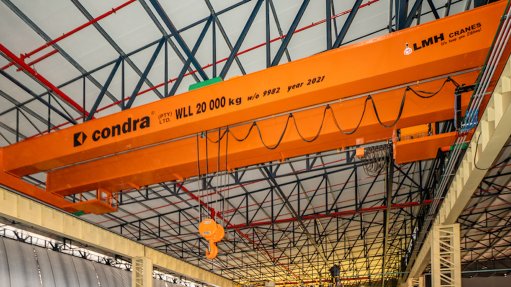
ISO-certified Condra manufactures overhead cranes, portal cranes, cantilever cranes and crane components: hoists, drives, end-carriages, brakes and...
VISIT SHOWROOM
As one of South Africa's leading manufacturers, Bell Equipment distributes and exports its wide range of heavy equipment globally to mining,...
VISIT SHOWROOM


Announcements
What's On
Subscribe to improve your user experience...
Option 1 (equivalent of R125 a month):
Receive a weekly copy of Creamer Media's Engineering News & Mining Weekly magazine
(print copy for those in South Africa and e-magazine for those outside of South Africa)
Receive daily email newsletters
Access to full search results
Access archive of magazine back copies
Access to Projects in Progress
Access to ONE Research Report of your choice in PDF format
Option 2 (equivalent of R375 a month):
All benefits from Option 1
PLUS
Access to Creamer Media's Research Channel Africa for ALL Research Reports, in PDF format, on various industrial and mining sectors
including Electricity; Water; Energy Transition; Hydrogen; Roads, Rail and Ports; Coal; Gold; Platinum; Battery Metals; etc.
Already a subscriber?
Forgotten your password?
Receive weekly copy of Creamer Media's Engineering News & Mining Weekly magazine (print copy for those in South Africa and e-magazine for those outside of South Africa)
➕
Recieve daily email newsletters
➕
Access to full search results
➕
Access archive of magazine back copies
➕
Access to Projects in Progress
➕
Access to ONE Research Report of your choice in PDF format
RESEARCH CHANNEL AFRICA
R4500 (equivalent of R375 a month)
SUBSCRIBEAll benefits from Option 1
➕
Access to Creamer Media's Research Channel Africa for ALL Research Reports on various industrial and mining sectors, in PDF format, including on:
Electricity
➕
Water
➕
Energy Transition
➕
Hydrogen
➕
Roads, Rail and Ports
➕
Coal
➕
Gold
➕
Platinum
➕
Battery Metals
➕
etc.
Receive all benefits from Option 1 or Option 2 delivered to numerous people at your company
➕
Multiple User names and Passwords for simultaneous log-ins
➕
Intranet integration access to all in your organisation