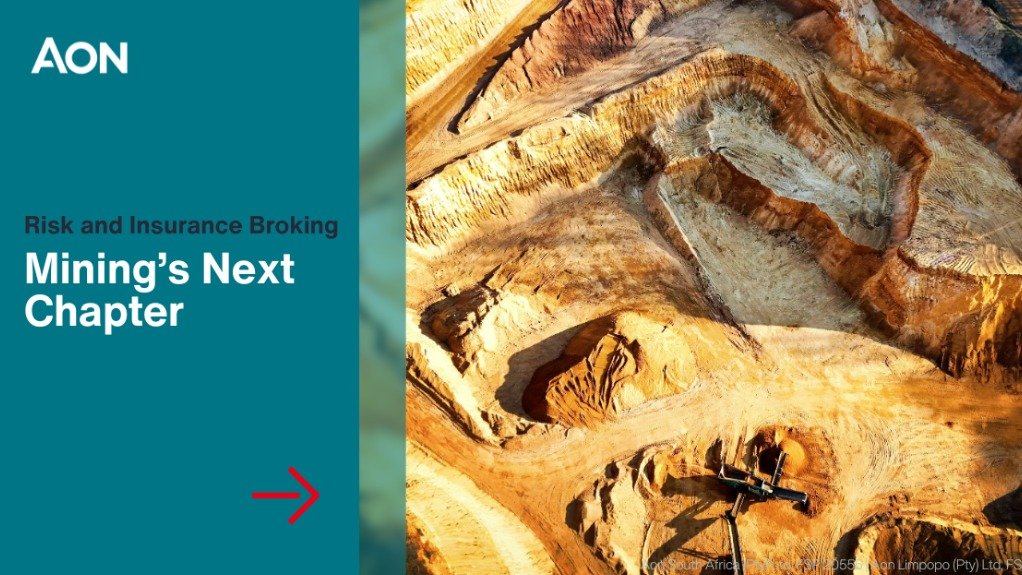
Mining’s Next Chapter



This article has been supplied.
The mining industry is undergoing significant transformation in terms of its approach to risk mitigation and management. Once characterised by a reactive mindset, today’s mining organisations are moving toward planned, focused and guided approaches to risk management, risk-bearing measurement and risk transfer.
This evolution has been hard-won. The sector’s history includes incidents that exposed the consequences of inadequate risk oversight - from the legacy of Vaal Reefs to more recent events such as the #Shaft11 incident. Yet these moments have become catalysts for change. Mining companies are increasingly learning not only from their own experiences, but also from those of their peers, adopting global standards and best-practice frameworks - even where these are not mandated.
A More Mature Approach to Risk
Across the sector, risk management has become a strategic priority rather than an operational afterthought. Mining companies are strengthening both internal and external risk transfer mechanisms, leveraging vehicles from cell captives to fully fledged captive insurers, and expanding cover beyond traditional lines to include cyber risk, directors’ and officers’ liability and large US-dollar-denominated programmes.
Protecting employees, managing legal liabilities to third parties and safeguarding physical assets are now embedded in long-term planning processes. Boards are asking tougher questions - not only about insured risks, but also about retained, uninsured and uninsurable exposures and how these are being proactively managed.
While mining has always been acutely aware of its top risks, the role of the financial services and insurance sectors has grown into a critical pillar of industry resilience. Together, these understandings are helping organisations quantify, prioritise and transfer risk more effectively in an increasingly complex operating environment.
The Risk Landscape Facing Natural Resources
Aon’s latest Global Risk Management Survey highlights the most pressing challenges confronting natural resources organisations today. These risks are highly interconnected, reinforcing the need for a more strategic, forward-looking approach to resilience.
The top 10 current risks include:
1. Business interruption
2. Regulatory or legislative change
3. Commodity price volatility or scarcity of materials
4. Environmental risk
5. Cyber-attack or data breach
6. Climate change
7. Property damage
8. Geopolitical volatility
9. Weather and natural disasters
10. Cash flow or liquidity risk
Business Interruption: More Than a Physical Disruption
Business interruption (BI) remains the leading concern, but its drivers are evolving rapidly. Traditional physical disruptions are now compounded by cyber threats, climate volatility and fragile supply chains, creating cascading impacts that delay production, disrupt capital projects and erode investor confidence. Rising input costs are also pushing break-even thresholds higher, delaying final investment decisions on major projects and forcing renegotiations of engineering, procurement and construction contracts or the search for alternative local suppliers. As mining operations become more automated, new single points of failure emerge, amplifying the potential impact of disruptions.
In response, organisations are reassessing BI coverage to reflect both traditional and emerging exposures, including cyber-triggered outages and climate-related events. Diversified supply chains, predictive maintenance and scenario modelling are becoming essential tools, while parametric solutions are increasingly used to unlock rapid liquidity following predefined events and accelerate recovery.
Cyber Risk: An Expanding Exposure
As mining operations become more digitalised, cyber risk is emerging as a systemic vulnerability. Autonomous equipment, smart grids and remote-controlled operations increase efficiency, but they also expand attack surfaces. Given the sector’s role in critical infrastructure, mining organisations are becoming more attractive targets for cybercriminals.
Although cyber risk did not feature among the top 10 risks identified by mining organisations in the survey, it ranked in the top five for power generation, oil and gas, and renewables - a warning signal for mining leaders. Legacy systems, siloed recovery plans and uneven cyber maturity can all extend downtime and exacerbate operational disruption.
Building resilience requires a holistic approach, including reassessing cyber maturity across both IT and operational technology environments, strengthening controls such as multi-factor authentication and network segmentation, and investing in real-time monitoring. Cyber insurance programmes should also reflect operational realities, including cover for business interruption and data recovery, supported by regular penetration testing and employee training.
Three Actions to Navigate Ongoing Disruption
In an environment defined by uncertainty and accelerating change, traditional risk management alone is no longer sufficient. Mining organisations can strengthen resilience by focusing on three key actions:
- Use data and analytics to quantify and prioritise risk - Advanced analytics enable organisations to understand their total cost of risk and identify hidden exposures. By integrating operational, financial and strategic data, leaders can allocate capital more effectively, design targeted risk transfer strategies and improve decision-making through scenario modelling and predictive insights.
- Leverage alternative risk transfer to manage volatility - Alternative risk transfer solutions - including captives, parametric insurance and insurance-linked securities - are increasingly used to address gaps in traditional cover. These tools can unlock new sources of capital, improve liquidity and enhance capital efficiency in the face of volatile risk profiles.
- Reframe risk management as a driver of value - Leading organisations are reframing risk management from a defensive necessity into a strategic value driver. By aligning risk financing with business objectives and embedding risk considerations into capital decisions, companies can optimise returns, strengthen stakeholder confidence and build long-term resilience.
A Sector Looking Forward
Mining’s story is no longer one of reacting to risk. It is increasingly about anticipation, preparation and informed decision-making. Through stronger governance, more sophisticated risk financing and closer collaboration with risk and insurance partners, the industry is demonstrating that its future can be defined not by past failures, but by resilience, adaptability and sustained value creation.
Article Enquiry
Email Article
Save Article
Feedback
To advertise email advertising@creamermedia.co.za or click here

Projects

Latest Multimedia


Latest News
Showroom
Virtual Gas Network supplies compressed natural gas via a virtual gas distribution network.
VISIT SHOWROOM
For over 15 years, Lilak Aluminium, a trusted leader in architectural extrusion supply, has delivered excellence to businesses like yours.
VISIT SHOWROOM
Announcements
What's On
Subscribe to improve your user experience...
Option 1 (equivalent of R125 a month):
Receive a weekly copy of Creamer Media's Engineering News & Mining Weekly magazine
(print copy for those in South Africa and e-magazine for those outside of South Africa)
Receive daily email newsletters
Access to full search results
Access archive of magazine back copies
Access to Projects in Progress
Access to ONE Research Report of your choice in PDF format
Option 2 (equivalent of R375 a month):
All benefits from Option 1
PLUS
Access to Creamer Media's Research Channel Africa for ALL Research Reports, in PDF format, on various industrial and mining sectors
including Electricity; Water; Energy Transition; Hydrogen; Roads, Rail and Ports; Coal; Gold; Platinum; Battery Metals; etc.
Already a subscriber?
Forgotten your password?
Receive weekly copy of Creamer Media's Engineering News & Mining Weekly magazine (print copy for those in South Africa and e-magazine for those outside of South Africa)
➕
Recieve daily email newsletters
➕
Access to full search results
➕
Access archive of magazine back copies
➕
Access to Projects in Progress
➕
Access to ONE Research Report of your choice in PDF format
RESEARCH CHANNEL AFRICA
R4500 (equivalent of R375 a month)
SUBSCRIBEAll benefits from Option 1
➕
Access to Creamer Media's Research Channel Africa for ALL Research Reports on various industrial and mining sectors, in PDF format, including on:
Electricity
➕
Water
➕
Energy Transition
➕
Hydrogen
➕
Roads, Rail and Ports
➕
Coal
➕
Gold
➕
Platinum
➕
Battery Metals
➕
etc.
Receive all benefits from Option 1 or Option 2 delivered to numerous people at your company
➕
Multiple User names and Passwords for simultaneous log-ins
➕
Intranet integration access to all in your organisation