New facility advances post processing technology

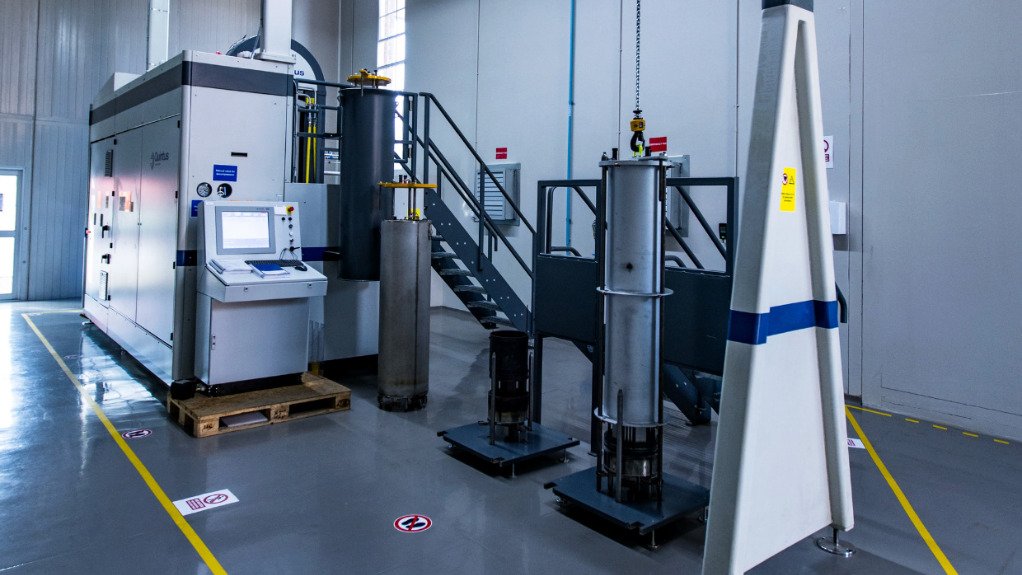
HOT OFF THE PRESS The Hot Isostatic Press facility enhances the performance and reliability of cast components


Since commissioning its Hot Isostatic Press (HIP) facility – unveiled at its Scientia campus in Pretoria, on December 11, 2025 – national research organisation Council for Scientific and Industrial Research (CSIR) notes that the facility has been positioned as a strategic national asset, enabling industry-led demonstration projects across casting, powder metallurgy and additive manufacturing.
The focus of the HIP facility is to drive component level feasibility studies, performance enhancement, qualification pathways and techno-economic validation, supported by advanced characterisation techniques.
“Early work has begun to build local performance datasets, developing application-specific HIP and heat-treatment strategies,” says CSIR Advanced Casting Technologies group leader Dr Velaphi Matjeke.
He adds that the facility will also develop end-to-end industrial qualification workflows, with project timelines typically spanning less than seven days, enabling “rapid decision-making” before scale-up.
“The HIP facility represents a step-change in South Africa’s ability to enhance the performance and reliability of die-cast components beyond what is achievable through casting alone.”
Matjeke explains that HIP exposes components to simultaneous high temperature and isostatic gas pressure, enabling a controlled reduction in the size, severity and connectivity of internal volumetric flaws such as gas porosity and micro-shrinkage.
“This promotes a more homogeneous internal structure, improved load transfer across the microstructure, and increased confidence in downstream manufacturing and qualification,” he explains.
Additionally, rather than replacing casting with powder metallurgy, HIP complements and extends its capability, unlocking higher mechanical properties, supporting weight reduction strategies, and increasing confidence in component qualification without major tooling changes.
The breakthrough translates into enhanced fatigue and damage tolerances, particularly under cyclic or thermal loading for the die-casting sector. It also improves the structural integrity and durability of cast components, while offering greater process robustness and reducing sensitivity to unavoidable casting variability.
“Overall, HIP enables die-cast components to be engineered for higher performance envelopes, unlocking applications that would otherwise be constrained by internal quality limitations,” says Matjeke.
A Facility that Facilitates
The HIP facility is designed to support local companies in advancing their products by enhancing the strength and durability of metal components.
Its establishment was made possible through National Equipment Programme funding from the Department of Science, Technology and Innovation.
“We assist industries in developing their own pressing processes. We do this by identifying the parameters suitable for the production of a particular component, and we conduct research based on that identification,” says CSIR senior engineer Maurice Maliage.
The CSIR’s team of experts completes “rigorous” tests before and after pressing, using metrology equipment and X-rays to ensure that the parts are free from pores and potential weak spots or defects.
“We start by taking X-rays to check for defects,” says Maliage, adding that from there, the team measures the dimensions of the part before it is pressed at a certain temperature and pressure, in line with client requests.
After pressing, a second check for pores or defects is conducted, and the part’s dimensions are rechecked to ensure there are no distortions.
Fabrication company Metallurgical and Manufacturing Services (MMS) CEO Dion Greyling – one of the HIP facility’s first clients – highlights the significance of the process.
“We are very excited about the reintroduction of HIP in South Africa, because its being available aids development and potential commercial advancements,” he says.
Greyling stresses that the mechanical properties that MMS has observed after testing the HIP product exceed the powder manufacturer’s “best ever results”.
“It is phenomenal that we can revitalise the metals industry,” he comments.
Matjeke adds that HIP processing introduces microstructural refinement and densification effects that are well established internationally and are now being localised through CSIR-led characterisation programmes.
Crucially, HIP is most effective when integrated with conventional or tailored heat-treatment cycles, supporting alloy homogenisation, residual stress reduction and optimisation.
“The combined effect of HIP and heat treatment is a more stable, damage-tolerant microstructure that supports longer service life and more aggressive design allowables,” concludes Matjeke.
Article Enquiry
Email Article
Save Article
Feedback
To advertise email advertising@creamermedia.co.za or click here
Research Reports

Projects
Latest Multimedia


Latest News

Showroom

Complete range of security sealing solutions including security seals bags and labels.
VISIT SHOWROOM
Design, Construction and Maintenance of Site Erected, Welded Bulk Storage Tanks for the Petrochemical, LNG, Ammonia and Sustainable fuel Sectors.
VISIT SHOWROOM



Announcements
What's On
Subscribe to improve your user experience...
Option 1 (equivalent of R125 a month):
Receive a weekly copy of Creamer Media's Engineering News & Mining Weekly magazine
(print copy for those in South Africa and e-magazine for those outside of South Africa)
Receive daily email newsletters
Access to full search results
Access archive of magazine back copies
Access to Projects in Progress
Access to ONE Research Report of your choice in PDF format
Option 2 (equivalent of R375 a month):
All benefits from Option 1
PLUS
Access to Creamer Media's Research Channel Africa for ALL Research Reports, in PDF format, on various industrial and mining sectors
including Electricity; Water; Energy Transition; Hydrogen; Roads, Rail and Ports; Coal; Gold; Platinum; Battery Metals; etc.
Already a subscriber?
Forgotten your password?
Receive weekly copy of Creamer Media's Engineering News & Mining Weekly magazine (print copy for those in South Africa and e-magazine for those outside of South Africa)
➕
Recieve daily email newsletters
➕
Access to full search results
➕
Access archive of magazine back copies
➕
Access to Projects in Progress
➕
Access to ONE Research Report of your choice in PDF format
RESEARCH CHANNEL AFRICA
R4500 (equivalent of R375 a month)
SUBSCRIBEAll benefits from Option 1
➕
Access to Creamer Media's Research Channel Africa for ALL Research Reports on various industrial and mining sectors, in PDF format, including on:
Electricity
➕
Water
➕
Energy Transition
➕
Hydrogen
➕
Roads, Rail and Ports
➕
Coal
➕
Gold
➕
Platinum
➕
Battery Metals
➕
etc.
Receive all benefits from Option 1 or Option 2 delivered to numerous people at your company
➕
Multiple User names and Passwords for simultaneous log-ins
➕
Intranet integration access to all in your organisation