Cooperation key to mining partnerships



STEPHEN SEAKA While Africa holds close to a third of the world’s known reserves of future-facing minerals, they are widely dispersed
SHIRLEY WEBBER Turning minerals and associated logistics frameworks into functioning mining corridors will require governments to plan power, water, data connectivity and skills development jointly, rather than in isolation




With this year’s Investing in African Mining Indaba set to focus on the theme Stronger together: Progress through partnerships, deeper regional cooperation will be critical to building a resilient and competitive African mining ecosystem, report financial services provider Absa Commercial and Investment Banking (CIB) managing principal, and resources and energy head Shirley Webber and Absa CIB public sector and growth capital solutions managing executive Stephen Seaka.
They posit that collaboration between governments, mining companies, investors, communities and infrastructure providers must increasingly take place across borders, reflecting the regional nature of Africa’s mineral endowment and the scale required to support global value chains linked to the energy transition.
While Africa holds close to a third of the world’s known reserves of future-facing minerals including the metals driving the global energy transition – copper, cobalt, manganese, graphite, nickel, lithium and the platinum group metals – Webber and Seaka point out that they are widely dispersed.
“With the International Energy Agency projecting sharply higher demand for key battery metals and transition-linked commodities over the next two to three decades, Africa’s mineral endowment places it at the centre of an emerging geopolitical and industrial reordering,” they say, noting that this makes the case for regional thinking almost self-evident.
However, Webber and Seaka note that many continental strategies blur the distinction between regional cooperation and regional approaches to beneficiation.
“Regional cooperation is about how States organise the rules of the game across borders. It includes tariff alignment, customs procedures, rail and port concessions, environmental and social standards, power-pool governance, dispute-resolution mechanisms and the regulatory treatment of long-term public-private partnerships,” they state.
Regional beneficiation, by contrast, is about where along the value chain different activities are located and how those activities are sequenced, point out Webber and Seaka.
They add that while ore can be crushed, concentrated, smelted, refined, turned into precursors, assembled into components and eventually integrated into finished products, some of these steps require substantial power and water, while others are knowledge-intensive, highly trade-exposed and shaped by logistics costs.
“It seldom makes sense to duplicate each step in every country that hosts a deposit. It is more efficient to map which segments of a copper-cobalt-manganese-lithium chain should sit in which locations along a corridor, then design fiscal regimes, power investments and skills programmes accordingly,” highlight Webber and Seaka.
Nonetheless, both agree that Africa’s continental policy landscape is starting to move in this direction, exemplified by the African Union’s Green Minerals Strategy positioning critical minerals as a regional industrialisation opportunity and promoting integrated value chains and corridor-based infrastructure planning.
Partnerships
In practice, turning these minerals and associated logistics frameworks into functioning corridors requires a different discipline from governments, say Webber and Seaka.
In this vein, they say a new approach is required whereby a minerals corridor is treated as a single planning unit for power, water, data connectivity and skills, even while it traverses several jurisdictions.
“It means aligning fiscal terms enough to prevent destructive competition for smelters and refineries, while allowing differentiated incentives where countries have distinct industrial strengths. It also demands joint approaches to environmental and social governance, so that high standards become a feature of the corridor rather than a source of regulatory arbitrage,” they add.
Meanwhile, Webber and Seaka point to the emerging success of the Lobito Corridor being a case in point for such cooperation and coordination.
In 2023, a mine operating along the Central African Copperbelt moved its first test consignment through the Lobito Corridor, using the refurbished rail spine that links the Democratic Republic of Congo (DRC) to Angola’s Atlantic coast, they highlight.
Roughly 1 100 t of copper concentrate from the Kamoa-Kakula complex in Kolwezi, in the DRC, were loaded at the Impala Terminals facility and sent west by rail to the Port of Lobito, in Angola.
“The journey took eight days. Until this trial run, more than nine-tenths of the mine’s output had been routed through Durban [South Africa] or Dar es Salaam [Tanzania], where a single turnaround typically stretched to six weeks,” note Webber and Seaka.
As such, successful minerals-specific corridors assist mining companies and their supply chains in attracting mining- and beneficiation-related investment as a result of such corridors providing predictable corridor-wide frameworks on transport, power pricing, fiscal regimes and environmental standards.
In all, if Africa continues to negotiate in small, fragmented units, Webber and Seaka state that the result will be a patchwork of export restrictions and incentive schemes that strain investor confidence without building the connective tissue of shared infrastructure and industrial capacity.
“If, instead, leaders use projects such as the Lobito Corridor as prototypes for how to align geology, logistics, and industrial policy at a regional scale, the continent can begin to shape global value chains rather than simply feeding into them,” they conclude.
Article Enquiry
Email Article
Save Article
Feedback
To advertise email advertising@creamermedia.co.za or click here
Research Reports


Projects


Latest Multimedia


Latest News

Showroom

ATI systems comprises five divisions: electrical assemblies, drives and controls, feedback sensors, enclosures, and strip guiding.
VISIT SHOWROOM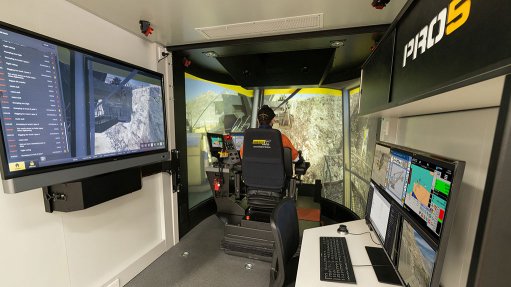
Immersive Technologies is the world's largest, proven and tested supplier of simulator training solutions to the global resources industry.
VISIT SHOWROOM

Press Office
Announcements
What's On
Subscribe to improve your user experience...
Option 1 (equivalent of R125 a month):
Receive a weekly copy of Creamer Media's Engineering News & Mining Weekly magazine
(print copy for those in South Africa and e-magazine for those outside of South Africa)
Receive daily email newsletters
Access to full search results
Access archive of magazine back copies
Access to Projects in Progress
Access to ONE Research Report of your choice in PDF format
Option 2 (equivalent of R375 a month):
All benefits from Option 1
PLUS
Access to Creamer Media's Research Channel Africa for ALL Research Reports, in PDF format, on various industrial and mining sectors
including Electricity; Water; Energy Transition; Hydrogen; Roads, Rail and Ports; Coal; Gold; Platinum; Battery Metals; etc.
Already a subscriber?
Forgotten your password?
Receive weekly copy of Creamer Media's Engineering News & Mining Weekly magazine (print copy for those in South Africa and e-magazine for those outside of South Africa)
➕
Recieve daily email newsletters
➕
Access to full search results
➕
Access archive of magazine back copies
➕
Access to Projects in Progress
➕
Access to ONE Research Report of your choice in PDF format
RESEARCH CHANNEL AFRICA
R4500 (equivalent of R375 a month)
SUBSCRIBEAll benefits from Option 1
➕
Access to Creamer Media's Research Channel Africa for ALL Research Reports on various industrial and mining sectors, in PDF format, including on:
Electricity
➕
Water
➕
Energy Transition
➕
Hydrogen
➕
Roads, Rail and Ports
➕
Coal
➕
Gold
➕
Platinum
➕
Battery Metals
➕
etc.
Receive all benefits from Option 1 or Option 2 delivered to numerous people at your company
➕
Multiple User names and Passwords for simultaneous log-ins
➕
Intranet integration access to all in your organisation