Significant new platinum-linked green hydrogen advances sweeping across UAE and US

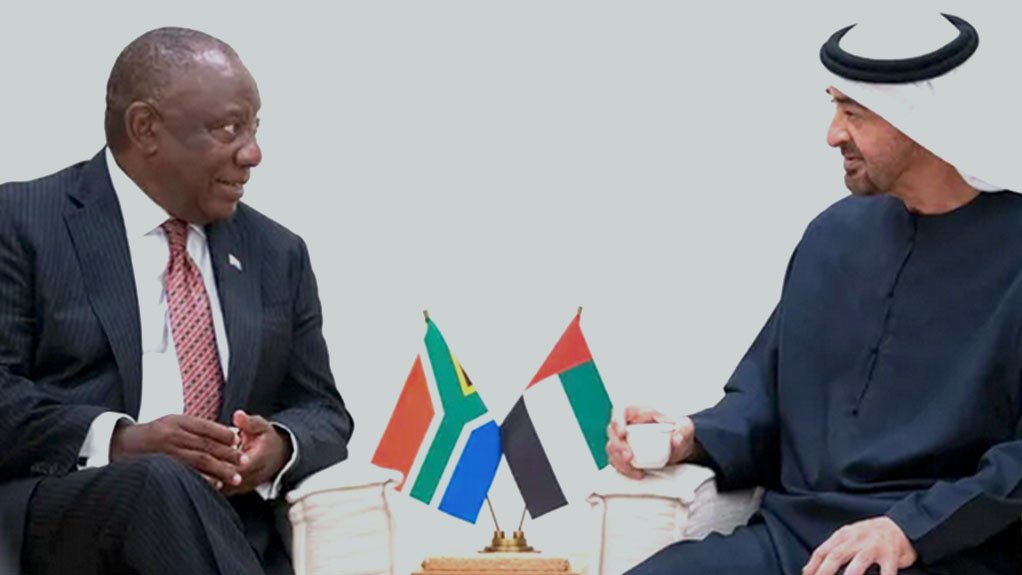
President Cyril Ramaphosa (left) with UAE President Sheikh Mohamed bin Zayed Al Nahyan.


JOHANNESBURG (miningweekly.com) – Speaking at the Abu Dhabi Sustainability Week on Tuesday, South African President Cyril Ramaphosa positioned green hydrogen at the centre of Africa’s big energy opportunity – and then on Wednesday in the US, speakers at the Washington-based Fuel Cell & Hydrogen Energy Association webinar heralded expanded tax-benefit business structures through America's' Master Limited Partnerships as the harbingers of new sought-after US hydrogen expansion. Master Limited Partnerships are business structures that have been used for many years to build out capital intensive infrastructure.
In discussion with UAE President Sheikh Mohamed bin Zayed Al Nahyan at the sustainability event, Ramaphosa emphasised the extent to which Africa’s abundant sunshine, strong wind corridors, powerful river systems, and critical minerals place the continent in a distinctive position to lead the world in green hydrogen production.
In the UAE, the headlines were ‘Ramaphosa touts green hydrogen as cornerstone of Africa’s energy, growth future’ and 'Africa is where green hydrogen can be utilised to a highly significant extent'.
Meanwhile, the World Platinum Investment Council reports that China has completed the world’s largest hydrogen refuelling station in Hami, Xinjiang, as part of its drive to decarbonise heavy transport.
The facility, in trial operation, can dispense up to 10 t of hydrogen daily, twice the capacity of Europe’s largest site, and refuel around 300 vehicles a day.
The Xuanli station integrates hydrogen production and refuelling on a single 19 500 m2 site, featuring eight high-capacity islands capable of serving eight fuel-cell trucks simultaneously.
Core equipment, including advanced compressors and control systems, was developed by Beijing Haidleyson Technology to ensure safety and efficiency in extreme temperatures.
The project reflects China’s preference for large-scale, vertically integrated hydrogen hubs, contrasting with Europe’s smaller distributed stations.
Hydrogen is seen as critical for cutting emissions in freight and other hard-to-abate sectors, and the station is expected to accelerate adoption of fuel-cell vehicles while supporting national carbon neutrality goals.
Analysts see the development as underscoring China’s ambition to lead in hydrogen infrastructure, positioning the technology as a practical pillar of its energy transition rather than a distant target.
Then, last week in the US, on a solar site in the State of Florida, the New York Stock Exchange-listed Duke Energy demonstrated the production, storage and use of green hydrogen, which followed the Nasdaq-listed hydrogen fuel cell company, Plug Power, signing a letter of intent to install a 5 MW platinum-based proton exchange membrane (PEM ) electrolyser at Sunrhyse, Hy2gen’s hydrogen production project in Signes, France. Plug will support the transport and distribution of hydrogen produced at Sunrhyse and continue expanding its turnkey hydrogen forklift solutions for logistics bases across the region.
Interestingly, Plug Power last year installed the same megawattage PEM electrolyser for Cleanergy Solutions of Namibia to support hydrogen-powered trucks, small ships and vehicles converted on site for dual-fuel operation using hydrogen and conventional fuels.
In California, Toyota Motor North America has announced a strategic investment in First Element Fuel, which is the largest retail hydrogen fuelling infrastructure provider in the large American state. First Element Fuel has 92 retail fuelling positions across 38 locations. Toyota and First Element Fuel aim to strengthen infrastructure for fuel cell electric vehicle (FCEV) drivers and bolster the hydrogen fuelling network for current and future generations of FCEVs.
Still in the US, fuel cell power systems company PowerCell has signed an agreement with a American data centre provider to supply two PowerCell fuel cell power systems for field validation in a data-centre application. The systems will be part of six- to 12-month lease arrangements.
In India, a hydrogen-powered train is undergoing final trials to transport tourists between Jiind and Sonipat. Powered by platinum-based fuel cells, the hydrogen-powered train will travel at a speed of up to 150 km/h.
“Hydrogen will play a crucial role in India's energy transition," Indian Renewable Energy Minister Pralhad Joshi forecast after driving a hydrogen fuel cell Toyota Mirai car through central New Delhi as part of a public demonstration of Indian government commitment to green hydrogen transport.
In Germany, a traditional railway line north of Berlin is pioneering a new zero-emission passenger train, powered by Ballard hydrogen fuel cells. A new hydrogen facility will be built by Enertrag in Wensickendorf to enable regional production of green hydrogen from wind and solar energy. The on-site facility has the capacity to produce up to 380 t/y of green hydrogen, with 230 t of that reserved for supplying the Heidekrautbahn railway line between Barnim and Berlin.
In Austria, energy company OMV has secured funding from federal development bank Austria Wirtschaftsservice to support a 140 MW green hydrogen electrolyser plant at Bruck an der Leitha as part of a project designed to produce up to 23 000 t/y of green hydrogen using renewable energy from wind, solar and hydropower. When commissioned at the end of 2027, the facility will rank among Europe’s top five green hydrogen plants.
In Japan, a contract has been signed with Kawasaki to build a 40 000 m3 liquefied hydrogen vessel at Sakaide. Project operator Japan Suiso Energy plans to perform trials under ocean-going conditions by 2030.
In Norway, Gen2 Energy has received confirmation of a total capacity reservation of up to 195 MW for a green hydrogen project at Nesbruket in Vefsn municipality. Work has begun on the project, which will be built in phases. Last year, the company signed a pact with Hamburg energy company MB Energy for liquid green hydrogen supply. The first phase of the project targets up to 30 t of liquefied green hydrogen a day, and over time production will be scaled up to the full capacity of 195 MW.
In Colombia, a nationwide government call has been made for proposals aimed at piloting low-emission hydrogen technologies across transport, industry and power. Colombia’s Atlantic and Pacific ports – especially Cartagena and Buenaventura – are to become hydrogen export gateways. Platinum-catalysed PEM systems have been mentioned by Hydrogen Fuel News as possibly featuring in the call for proposals.
In Egypt, a 100-MW green hydrogen project in partial operation has begun exports to Europe and the US as the country steps up efforts to position itself as a hub for clean fuels.
In South Africa at year-end, the many international business and policy leaders attending the year-end G20 and B20 Summits were chauffeured around Johannesburg in platinum-catalysed hydrogen fuel cell electric Toyota Mirai cars, which were refuelled by South Africa’s Air Products, with a full tank of hydrogen produced by South Africa’s Sasol providing sufficient energy for 500 km to 600 km journeys.
Also in South Africa, energy startup Hyena is setting out to reduce Africa’s reliance on diesel generators through its Power Pod earmarked for off-grid locations or those that have an unreliable energy supply. The system generates electricity from liquefied petroleum gas (LPG) without combustion by converting the LPG into hydrogen, which is then used in a fuel cell.
Last month Hyundai Motor Group signed a memorandum of understanding (MoU) to co-develop a maritime fuel cell system with HD Korea Shipbuilding & Offshore Engineering and Pusan National University. In terms of the MoU, the consortium will develop and demonstrate a maritime fuel cell system for liquefied hydrogen carriers. Hyundai Motor Company plans to develop a fuel cell system optimized for marine applications based on its existing fuel cell technology. HD Korea Shipbuilding & Offshore Engineering will carry out the integrated design of a hybrid electric propulsion system consisting of a hydrogen dual fuel engine and Hyundai’s maritime hydrogen fuel cell. Pusan National University will evaluate and demonstrate the system.
FUNDING OPPORTUNITIES
Overall, new funding opportunities are being lined up, with a competitive auction model emerging as the leading method of allocating production subsidies for clean hydrogen.
The goal is to secure fixed revenue streams for developers to firm up their projects’ bankability and get them to a final investment decision at the lowest possible cost to the public purse.
In France, the government has unveiled new rules for its 1 GW of national clean hydrogen subsidy auctions.
It is important to point out that platinum is crucial for hydrogen fuel cell mobility as well as the PEM electrolysers that generate the hydrogen. Platinum’s catalytic properties allow it to convert hydrogen into green electricity with water as the only by-product, offering zero-emission power for vehicles and industry.
Article Enquiry
Email Article
Save Article
Feedback
To advertise email advertising@creamermedia.co.za or click here


Projects
Latest Multimedia
Latest News
Showroom
Your global lifecycle technology & service partner for materials & minerals processing equipment for coal, iron ore, copper, manganese & other...
VISIT SHOWROOM
Leading condition monitoring specialists, WearCheck, help boost machinery lifespan and reduce catastrophic component failure through the scientific...
VISIT SHOWROOM
Press Office
Announcements
What's On
Subscribe to improve your user experience...
Option 1 (equivalent of R125 a month):
Receive a weekly copy of Creamer Media's Engineering News & Mining Weekly magazine
(print copy for those in South Africa and e-magazine for those outside of South Africa)
Receive daily email newsletters
Access to full search results
Access archive of magazine back copies
Access to Projects in Progress
Access to ONE Research Report of your choice in PDF format
Option 2 (equivalent of R375 a month):
All benefits from Option 1
PLUS
Access to Creamer Media's Research Channel Africa for ALL Research Reports, in PDF format, on various industrial and mining sectors
including Electricity; Water; Energy Transition; Hydrogen; Roads, Rail and Ports; Coal; Gold; Platinum; Battery Metals; etc.
Already a subscriber?
Forgotten your password?
Receive weekly copy of Creamer Media's Engineering News & Mining Weekly magazine (print copy for those in South Africa and e-magazine for those outside of South Africa)
➕
Recieve daily email newsletters
➕
Access to full search results
➕
Access archive of magazine back copies
➕
Access to Projects in Progress
➕
Access to ONE Research Report of your choice in PDF format
RESEARCH CHANNEL AFRICA
R4500 (equivalent of R375 a month)
SUBSCRIBEAll benefits from Option 1
➕
Access to Creamer Media's Research Channel Africa for ALL Research Reports on various industrial and mining sectors, in PDF format, including on:
Electricity
➕
Water
➕
Energy Transition
➕
Hydrogen
➕
Roads, Rail and Ports
➕
Coal
➕
Gold
➕
Platinum
➕
Battery Metals
➕
etc.
Receive all benefits from Option 1 or Option 2 delivered to numerous people at your company
➕
Multiple User names and Passwords for simultaneous log-ins
➕
Intranet integration access to all in your organisation